

CEFR B2
What you will learn
- Recognise the pattern taught in “lassen: leave, allow and have something done” in a short example.
- Choose the appropriate form from “lassen: leave, allow and have something done” using explicit evidence.
- Apply and justify the rule from “lassen: leave, allow and have something done” in a new case.
Before you start
- Recognise the vocabulary and forms shown in this lesson’s key idea and paradigm.
The idea
lassen changes frame depending on whether it is a lexical verb or governs another infinitive. The visible form may be the same, but its participants and Perfekt are not.
As a lexical verb, lassen can mean leaving something in a place, not taking it along or stopping an action, depending on the complement: Ich lasse die Jacke im Auto; Lass das! There is no second infinitive in this use. Its regular Perfekt is hat gelassen: Ich habe meine Jacke im Zug gelassen.
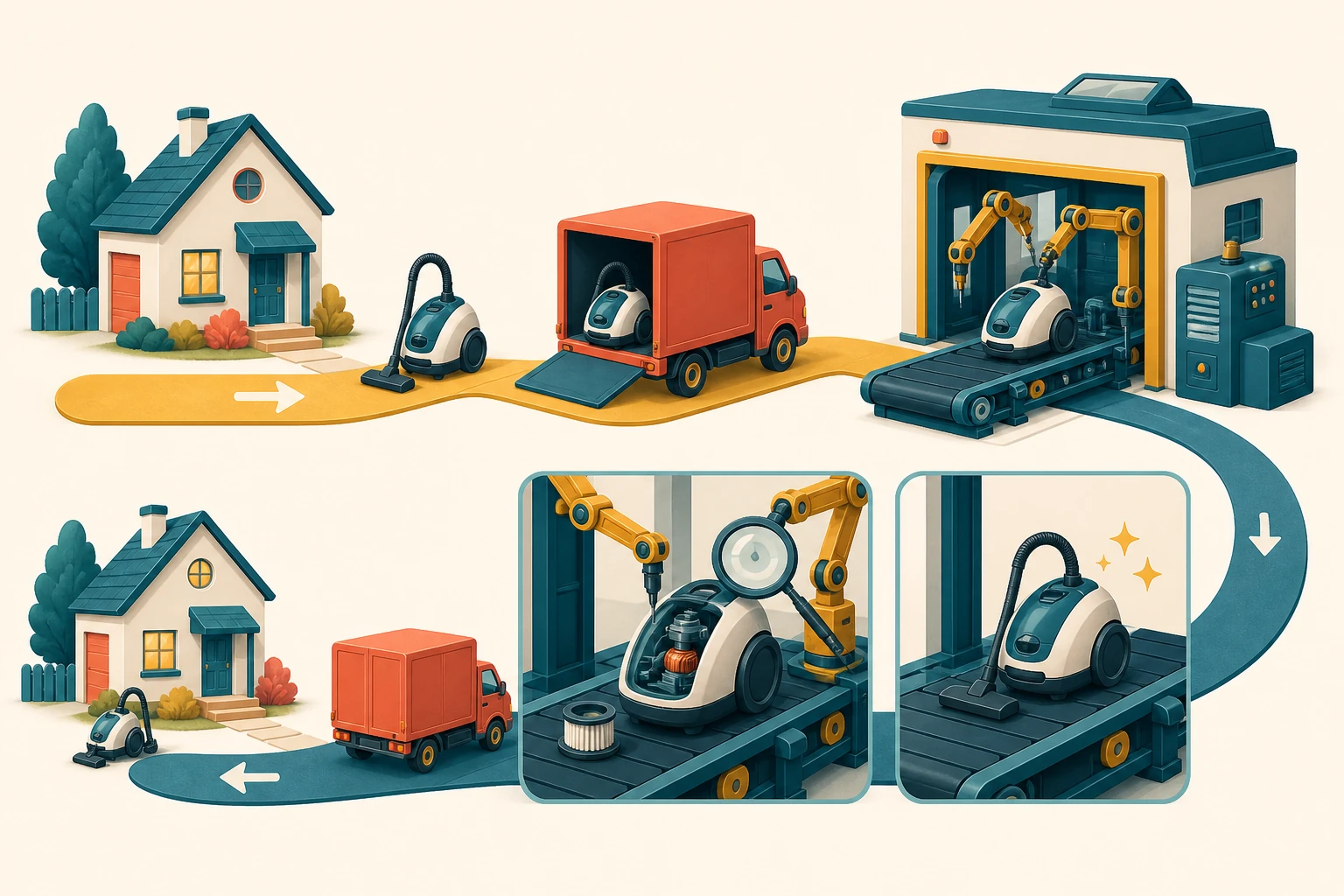
With an accusative plus a bare infinitive, lassen can express permission or causation. Die Eltern lassen das Kind draußen spielen means that they allow the child to play; Wir lassen die Anlage prüfen means that we arrange for someone to inspect the system. Syntax alone does not identify the exact relationship: subject type, action and context distinguish allowing from commissioning.
The participant carrying out the infinitive's action commonly appears in the accusative: Ich lasse den Techniker die Anlage prüfen. If the infinitive's object is a body part or something associated with a beneficiary, a dative is common: Ich lasse mir die Haare schneiden. mir is the beneficiary and die Haare is the object of schneiden.
The reflexive construction sich lassen + infinitive expresses possibility or feasibility and is often close to a passive with können: Das Problem lässt sich lösen is approximately equivalent to Das Problem kann gelöst werden. It does not state who performs the action and must not be confused with literally allowing oneself to undergo something.
The Perfekt separates two patterns. Standalone lassen uses gelassen; when it governs another infinitive it appears as an Ersatzinfinitiv: Wir haben die Heizung prüfen lassen, not prüfen gelassen. In a subordinate clause, the auxiliary precedes the infinitive block: weil wir die Heizung haben prüfen lassen. To solve a form, first locate whether there is a dependent infinitive; that decision determines both meaning and Perfekt form.
Present
| Item | Form |
|---|---|
| 1 | ich · lasse |
| 2 | du · lässt |
| 3 | er/sie/es · lässt |
| 4 | wir · lassen |
| 5 | ihr · lasst |
| 6 | sie/Sie · lassen |
Präteritum
| Item | Form |
|---|---|
| 1 | ich · ließ |
| 2 | du · ließest |
| 3 | er/sie/es · ließ |
| 4 | wir · ließen |
| 5 | ihr · ließt |
| 6 | sie/Sie · ließen |
Perfekt as a full verb
| Item | Form |
|---|---|
| 1 | ich · habe gelassen |
| 2 | du · hast gelassen |
| 3 | er/sie/es · hat gelassen |
| 4 | wir · haben gelassen |
| 5 | ihr · habt gelassen |
| 6 | sie/Sie · haben gelassen |
Valency patterns
| Item | Form |
|---|---|
| 1 | leave/keep · lassen + accusative + predicative/place · die Tür offen lassen |
| 2 | allow · lassen + accusative agent + infinitive · das Kind spielen lassen |
| 3 | have something done · lassen + object + infinitive · die Heizung prüfen lassen |
| 4 | beneficiary · dative + object + infinitive · mir die Haare schneiden lassen |
| 5 | possibility · sich lassen + infinitive · Das lässt sich erklären. |
Perfekt with infinitive
| Item | Form |
|---|---|
| 1 | causative · wir haben die Anlage prüfen lassen · weil wir die Anlage haben prüfen lassen |
| 2 | permission · sie hat das Kind spielen lassen · weil sie das Kind hat spielen lassen |
| 3 | beneficiary · ich habe mir die Haare schneiden lassen · weil ich mir die Haare habe schneiden lassen |
How it sounds
- Lass bitte die Tür offen.offen describes the state to be maintained.
- Die Chefin lässt den Bericht überarbeiten.The manager commissions the revision; überarbeiten has no zu.
- Die Datei lässt sich nicht öffnen.sich lassen presents opening the file as impossible in that context.
Check objective 1Another case
We ask a specialist to perform the calibration. Supply the infinitive after causative lassen: Wir lassen das Messgerät morgen ___.
We ask a specialist to perform the calibration. Supply the infinitive after causative lassen: Wir lassen das Messgerät morgen ___.
Answer available without interaction
Answer: kalibrieren — Causative lassen governs a bare infinitive: we arrange for the device to be calibrated.
Causative lassen governs a bare infinitive: we arrange for the device to be calibrated.
Answer: kalibrieren — Causative lassen governs a bare infinitive: we arrange for the device to be calibrated.
Causative lassen governs a bare infinitive: we arrange for the device to be calibrated.
Check objective 2Another case
A proposed answer is “zu archivieren” for this case: “Die Datei lässt sich leicht zu archivieren.”. Choose the only valid form.
A proposed answer is “archiviert” for this case: “Die Datei lässt sich leicht archiviert.”. Choose the only valid form.
Answer available without interaction
Answer: archivieren — The structure sich lassen + infinitive expresses feasibility: archiving is possible and easy.
sich lassen + infinitive expresses feasibility: archiving is possible and easy.
Answer: archivieren — The structure sich lassen + infinitive expresses feasibility: archiving is possible and easy.
sich lassen + infinitive expresses feasibility: archiving is possible and easy.
Check objective 3Another case
A proposed answer is “im Büro lassen” for this case: “Wo ist der Schlüssel? — Ich habe ihn im Büro lassen.”. Choose the only valid form.
A proposed answer is “im Büro ließ” for this case: “Wo ist der Schlüssel? — Ich habe ihn im Büro ließ.”. Choose the only valid form.
Answer available without interaction
Answer: im Büro gelassen — Here lassen is lexical and governs no other infinitive, so its Perfekt uses gelassen.
Here lassen is lexical and governs no other infinitive, so its Perfekt uses gelassen.
Answer: im Büro gelassen — Here lassen is lexical and governs no other infinitive, so its Perfekt uses gelassen.
Here lassen is lexical and governs no other infinitive, so its Perfekt uses gelassen.
When it doesn't hold
What breaks the rule, said out loud. Hiding it is what makes you feel cheated in the exam.
- In the imperative, lassen forms the collective proposal: let us go.Lass uns gehen!
- With an object and no verb, lassen means leave alone.Lass mich in Ruhe.
- A very common set phrase: it can be done, it is feasible.Das lässt sich machen.
What your own language pushes you to say
Wrong Ich mache mein Auto reparieren.
Right Ich lasse mein Auto reparieren.
English uses «have» or «get» for this —«I have my car repaired»— and the closest German word looks like machen, so the wrong verb gets picked for a structure that only lassen can carry.
Challenge: apply every rule
Solve every case and justify each choice: 1) A proposed answer is “zu kalibrieren” for this case: “Wir lassen das Messgerät morgen zu kalibrieren.”. Choose the only valid form. 2) A proposed answer is “zu archivieren” for this case: “Die Datei lässt sich leicht zu archivieren.”. Choose the only valid form. 3) A proposed answer is “im Büro lassen” for this case: “Wo ist der Schlüssel? — Ich habe ihn im Büro lassen.”. Choose the only valid form.
Answer available without interaction
- Recognise the pattern taught in “lassen: leave, allow and have something done” in a short example.
- Choose the appropriate form from “lassen: leave, allow and have something done” using explicit evidence.
- Apply and justify the rule from “lassen: leave, allow and have something done” in a new case.
Answer: kalibrieren · archivieren · im Büro gelassen
Causative lassen governs a bare infinitive: we arrange for the device to be calibrated. sich lassen + infinitive expresses feasibility: archiving is possible and easy. Here lassen is lexical and governs no other infinitive, so its Perfekt uses gelassen.
Continue along this corridor
Practise this: lassen: to leave, to have something done, to allow and to be doablePractise this: eine Entscheidung treffen: the verb that lives inside the nounModal particles: stance and common ground