

CEFR A2
What you will learn
- Recognise the pattern taught in “German subordinate clauses A2: finite verb last” in a short example.
- Choose the appropriate form from “German subordinate clauses A2: finite verb last” using explicit evidence.
- Apply and justify the rule from “German subordinate clauses A2: finite verb last” in a new case.
Before you start
- Recognise the vocabulary and forms shown in this lesson’s key idea and paradigm.
The idea
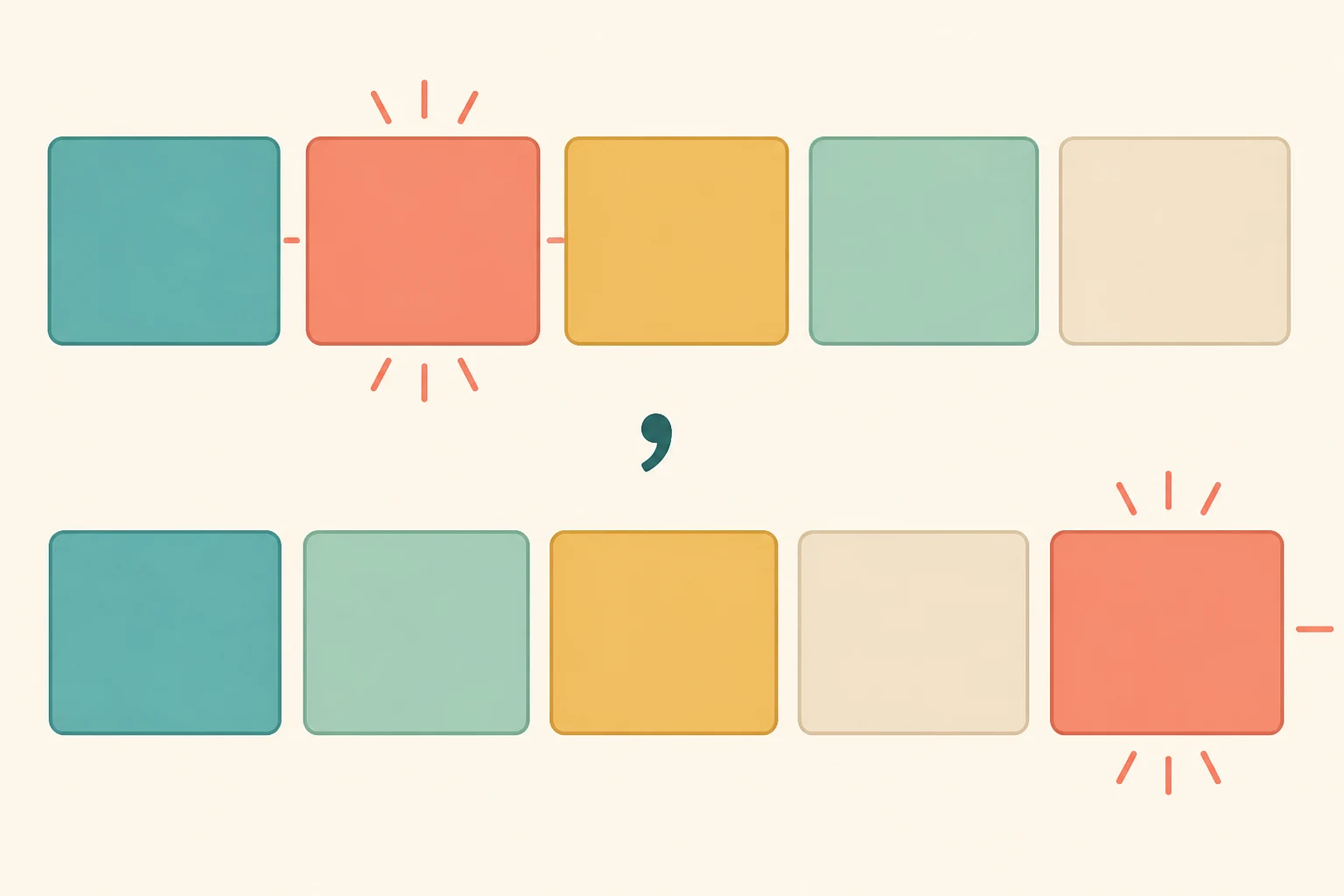
A subordinator occupies the first internal position of a subordinate clause and sends the verb group to the end; the finite form is the last component in basic A2 patterns.
weil introduces a reason; dass introduces the content of thoughts, statements or perceptions; wenn introduces conditions and many repeated or present/future situations; ob introduces an indirect yes/no question. They are not interchangeable even though they share word order.
In a main clause, the finite verb commonly occupies V2. In a subordinate clause: ..., weil er heute zu Hause bleibt. A comma separates the clauses. If the subordinate clause comes first, the whole clause fills the first position of the main clause and the main verb follows the comma immediately: Weil er krank ist, bleibt er zu Hause. Do not duplicate a pronoun before bleibt.
In the perfect, the participle precedes the finite auxiliary: ..., weil der Zug spät angekommen ist. With a simple modal, the lexical infinitive precedes the finite modal: ..., weil wir morgen arbeiten müssen. With separable verbs, the prefix is not detached when the finite form is final: ..., weil der Kurs um neun anfängt.
Apply “verb last” to the actual verb group, not by moving a memorised last word. Coordinators such as und, aber, oder and denn do not trigger subordinate order; the following clause keeps main-clause order.
Main clause and simple subordinate clause
| Item | Form |
|---|---|
| main clause | subject · finite verb · complements |
| subordinate clause | subordinator · subject · complements · finite verb |
Subordinate clause in the Perfekt
| Item | Form |
|---|---|
| 1 | subordinator · subject · complements · participle · finite auxiliary |
| structural example | weil · er · spät · angekommen · ist |
Subordinate clause with a modal
| Item | Form |
|---|---|
| 1 | subordinator · subject · complements · lexical infinitive · finite modal |
| structural example | weil · wir · morgen · arbeiten · müssen |
Subordinate clause first
| Item | Form |
|---|---|
| 1 | whole subordinate clause · comma · main-clause finite verb · subject/rest |
How it sounds
- Ich weiß, dass Nora heute frei hat.dass introduces the known content; hat is the final finite form.
- Wenn der Bus kommt, steigen wir ein.The initial subordinate clause occupies first position; steigen follows the comma immediately.
- Er fragt, ob das Geschäft geöffnet ist.ob turns a yes/no question into an indirect question.
Check objective 1Another case
A proposed answer is “arbeiten” for this case: “Ich gehe früher, weil ich morgen um sechs arbeiten.”. Choose the only valid form.
A proposed answer is “arbeitet” for this case: “Ich gehe früher, weil ich morgen um sechs arbeitet.”. Choose the only valid form.
Answer available without interaction
Answer: arbeite — The subordinate subject is ich; finite arbeite occupies final position.
The subordinate subject is ich; finite arbeite occupies final position.
Answer: arbeite — The subordinate subject is ich; finite arbeite occupies final position.
The subordinate subject is ich; finite arbeite occupies final position.
Check objective 2Another case
Mara sagt, dass sie den Schlüssel ___.
Mara sagt, dass sie den Schlüssel ___.
Answer available without interaction
Answer: gefunden hat — In a perfect subordinate clause, the participle precedes the final finite auxiliary: gefunden hat.
In a perfect subordinate clause, the participle precedes the final finite auxiliary: gefunden hat.
Answer: gefunden hat — In a perfect subordinate clause, the participle precedes the final finite auxiliary: gefunden hat.
In a perfect subordinate clause, the participle precedes the final finite auxiliary: gefunden hat.
Check objective 3Another case
Wenn der Termin endet, ___ wir Sie an.
Wenn der Termin endet, ___ wir Sie an.
Answer available without interaction
Answer: rufen — The initial subordinate clause occupies the main clause's first position, so rufen fills the gap before subject wir and an remains final.
The initial subordinate clause occupies the main clause's first position, so rufen fills the gap before subject wir and an remains final.
Answer: rufen — The initial subordinate clause occupies the main clause's first position, so rufen fills the gap before subject wir and an remains final.
The initial subordinate clause occupies the main clause's first position, so rufen fills the gap before subject wir and an remains final.
When it doesn't hold
What breaks the rule, said out loud. Hiding it is what makes you feel cheated in the exam.
- If two coordinated verbs live inside the subordinate clause, both go to the end.Er kommt nicht, weil er keine Zeit hat und müde ist.
- With verbs of opinion dass can be dropped, and then the order goes back to normal.Ich glaube, er kommt heute nicht.
- In a compound tense it is the auxiliary that takes the final slot, with the participle in front of it.Ich weiß, dass er gestern angerufen hat.
What your own language pushes you to say
Wrong Ich komme nicht, weil ich muss arbeiten.
Right Ich komme nicht, weil ich arbeiten muss.
English subordinate clauses keep the ordinary order, and with a modal the two verbs stay glued together. In German the modal has to jump behind its own infinitive.
Challenge: apply every rule
Solve every case and justify each choice: 1) A proposed answer is “arbeiten” for this case: “Ich gehe früher, weil ich morgen um sechs arbeiten.”. Choose the only valid form. 2) A proposed answer is “hat gefunden” for this case: “Mara sagt, dass sie den Schlüssel hat gefunden hat gefunden.”. Choose the only valid form. 3) A proposed answer is “wir rufen” for this case: “Wenn der Termin endet, wir rufen wir Sie an.”. Choose the only valid form.
Answer available without interaction
- Recognise the pattern taught in “German subordinate clauses A2: finite verb last” in a short example.
- Choose the appropriate form from “German subordinate clauses A2: finite verb last” using explicit evidence.
- Apply and justify the rule from “German subordinate clauses A2: finite verb last” in a new case.
Answer: arbeite · gefunden hat · rufen
The subordinate subject is ich; finite arbeite occupies final position. In a perfect subordinate clause, the participle precedes the final finite auxiliary: gefunden hat. The initial subordinate clause occupies the main clause's first position, so rufen fills the gap before subject wir and an remains final.
Continue along this corridor
Practise this: weil and dass: the clause where the verb goes to the endGerman adjective declension A2: complete tables