

CEFR C1
What you will learn
- Preserve the scope of negated unanimity.
- Distinguish logical content from unasserted existence.
- Test equivalence using cases and counterexamples.
Before you start
- Master final-verb subordination, cases and subject–verb relations at B1.
The idea
Nicht alle haben zugestimmt denies unanimous approval and permits some or none.
Nicht alle haben zugestimmt denies unanimous approval and permits some or none. Do not replace it automatically with niemand. If context supplies at least one approval, preserve it as additional evidence rather than obligatory meaning.
Surface form need not establish a single scope: Alle haben nicht… may be equivocal with focus and context. Use Niemand hat zugestimmt or Keiner… for zero approvals and Nicht alle… to deny unanimity. Do not base a key on unstated pragmatics.
nicht immer is not nie; nicht beide is not keiner von beiden. Check reformulations using a compatible case and a counterexample. Universals are content to interpret here, not signals for rejecting distractors without reading.
Relations to preserve
| Form | Reading and checking |
|---|---|
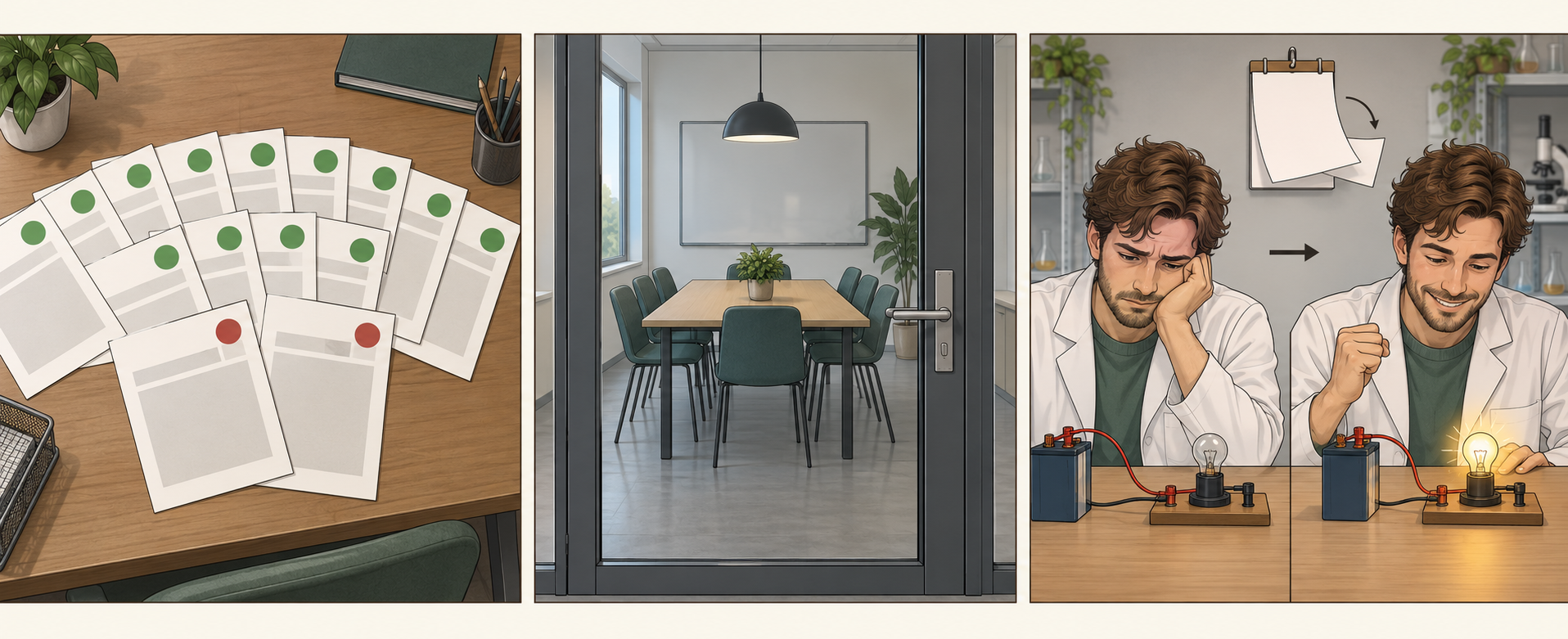
| Nicht alle Anträge wurden genehmigt; zwei wurden abgelehnt. | Nicht alle haben zugestimmt denies unanimous approval and permits some or none. Do not replace it automatically with niemand. If context supplies at least one approval, preserve it as additional evidence rather than obligatory meaning. |
| Niemand hat den Raum betreten. | Surface form need not establish a single scope: Alle haben nicht… may be equivocal with focus and context. Use Niemand hat zugestimmt or Keiner… for zero approvals and Nicht alle… to deny unanimity. Do not base a key on unstated pragmatics. |
| Der Versuch gelingt nicht immer; gestern gelang er. | nicht immer is not nie; nicht beide is not keiner von beiden. Check reformulations using a compatible case and a counterexample. Universals are content to interpret here, not signals for rejecting distractors without reading. |
How it sounds
- Nicht alle Anträge wurden genehmigt; zwei wurden abgelehnt.Approval of all applications is denied and two refusals are specified. The number approved is not stated.
- Niemand hat den Raum betreten.Niemand denies that any person entered. It differs from Nicht alle, which only denies that everyone entered.
- Der Versuch gelingt nicht immer; gestern gelang er.nicht immer leaves frequency open and denies success on every occasion; gestern gelang er adds a specific success.
Preserve the relationAnother case and answer
Choose the answer meeting the task and its German justification. Read the alternatives before checking. Vier Personen: drei stimmen zu, eine enthält sich. Welche Fassung bewahrt genau die fehlende Einstimmigkeit ohne eine Ablehnung zu erfinden?
Choose the answer meeting the task and its German justification. Read the alternatives before checking. Nicht beide Türen waren verschlossen. Welche Belegung ist mit dieser Aussage vereinbar, ohne eine weitere Tatsache zu unterstellen?
Answer available without interaction
Answer: Nicht alle haben dem Vorschlag zugestimmt. — Die fehlende Einstimmigkeit lässt die drei Zustimmungen bestehen.
Abstention defeats unanimity without being rejection. niemand erases three approvals; abgelehnt invents rejection.
Answer: Eine Tür war verschlossen, die andere nicht. — Genau eine verschlossene Tür erfüllt die gegebene Negation.
One closed and one open is compatible. Alternatives assert the negated double state or its necessity.
Check the reformulationAnother case and answer
Choose the answer meeting the task and its German justification. Read the alternatives before checking. Der Satz lautet nur: Nicht alle Geräte wurden geprüft. Welche Zusatzbehauptung ist logisch noch offen?
Choose the answer meeting the task and its German justification. Read the alternatives before checking. Ein Bericht meint ausdrücklich: Von den sechs Zeugen hat keiner unterschrieben. Welche Fassung vermeidet die mögliche Skopusunsicherheit von Alle haben nicht unterschrieben?
Answer available without interaction
Answer: Mindestens ein Gerät wurde tatsächlich geprüft. — Die Aussage wird um eine positive Existenzbehauptung erweitert.
Zero devices may have been checked. Only checking every device is excluded; an actual check requires additional evidence.
Answer: Keiner der sechs Zeugen hat unterschrieben. — Die Anzahl der Unterzeichnenden wird auf null festgelegt.
Keiner fixes zero. The other sentences allow signatures and lose the stated count’s precision.
Evaluate the scopeAnother case and answer
Choose the answer meeting the task and its German justification. Read the alternatives before checking. In diesem Monat gelang der Versuch an zwei Tagen und scheiterte an drei Tagen. Welche Fassung erhält Erfolge und Misserfolge?
Choose the answer meeting the task and its German justification. Read the alternatives before checking. Eine Behauptung setzt Nicht alle waren anwesend mit Niemand war anwesend gleich. Welcher Fall widerlegt genau diese Gleichsetzung?
Answer available without interaction
Answer: Der Versuch gelang in diesem Monat nicht immer. — Erfolge und Misserfolge passen zu nicht immer.
Two successes and three failures rule out nie and ohne Ausnahme; nicht immer permits the observed pattern.
Answer: Zwei von drei Mitgliedern waren anwesend. — Teilweise Anwesenheit trennt die beiden Bedeutungen.
Two attendees satisfy nicht alle but contradict niemand. Zero satisfies both; announcement does not determine attendance.
When it doesn't hold
What breaks the rule, said out loud. Hiding it is what makes you feel cheated in the exam.
- Niemand denies that any person entered. It differs from Nicht alle, which only denies that everyone entered.Niemand hat den Raum betreten.
- nicht immer leaves frequency open and denies success on every occasion; gestern gelang er adds a specific success.Der Versuch gelingt nicht immer; gestern gelang er.
What your own language pushes you to say
Wrong Niemand löste die Aufgabe.
Right Nicht alle lösten die Aufgabe.
Context: seven people solved the task and three did not. Niemand would erase the seven successes. Nicht alle denies totality; the additional facts specify the distribution here.
Transfer to a new case
Solve the new case in German and justify the decisions. Check against the criteria, not just the model wording. Sechs Berichte: vier geprüft, zwei ungeprüft. Von drei Anträgen wurde keiner genehmigt. Die Prüfung gelang am Montag, scheiterte am Dienstag. Schreibe eine präzise Zusammenfassung mit nicht alle, keiner und nicht immer. Gib für jeden Satz an, welche stärkere oder schwächere Reformulierung den dokumentierten Stand verlieren würde.
Answer available without interaction
- Preserve the scope of negated unanimity.
- Distinguish logical content from unasserted existence.
- Test equivalence using cases and counterexamples.
Answer: Nicht alle sechs Berichte wurden geprüft: vier wurden geprüft, zwei blieben ungeprüft. Keiner der drei Anträge wurde genehmigt. Die Prüfung gelang nicht immer: am Montag gelang sie, am Dienstag scheiterte sie.
Justification distinguishes not all from none, none from not all, and not always from never. Accept clear equivalent wording preserving these quantifiers and cases, without exact matching.