

CEFR A2
What you will learn
- Recognise the pattern taught in “German two-way prepositions A2” in a short example.
- Choose the appropriate form from “German two-way prepositions A2” using explicit evidence.
- Apply and justify the rule from “German two-way prepositions A2” in a new case.
Before you start
- Recognise the vocabulary and forms shown in this lesson’s key idea and paradigm.
The idea
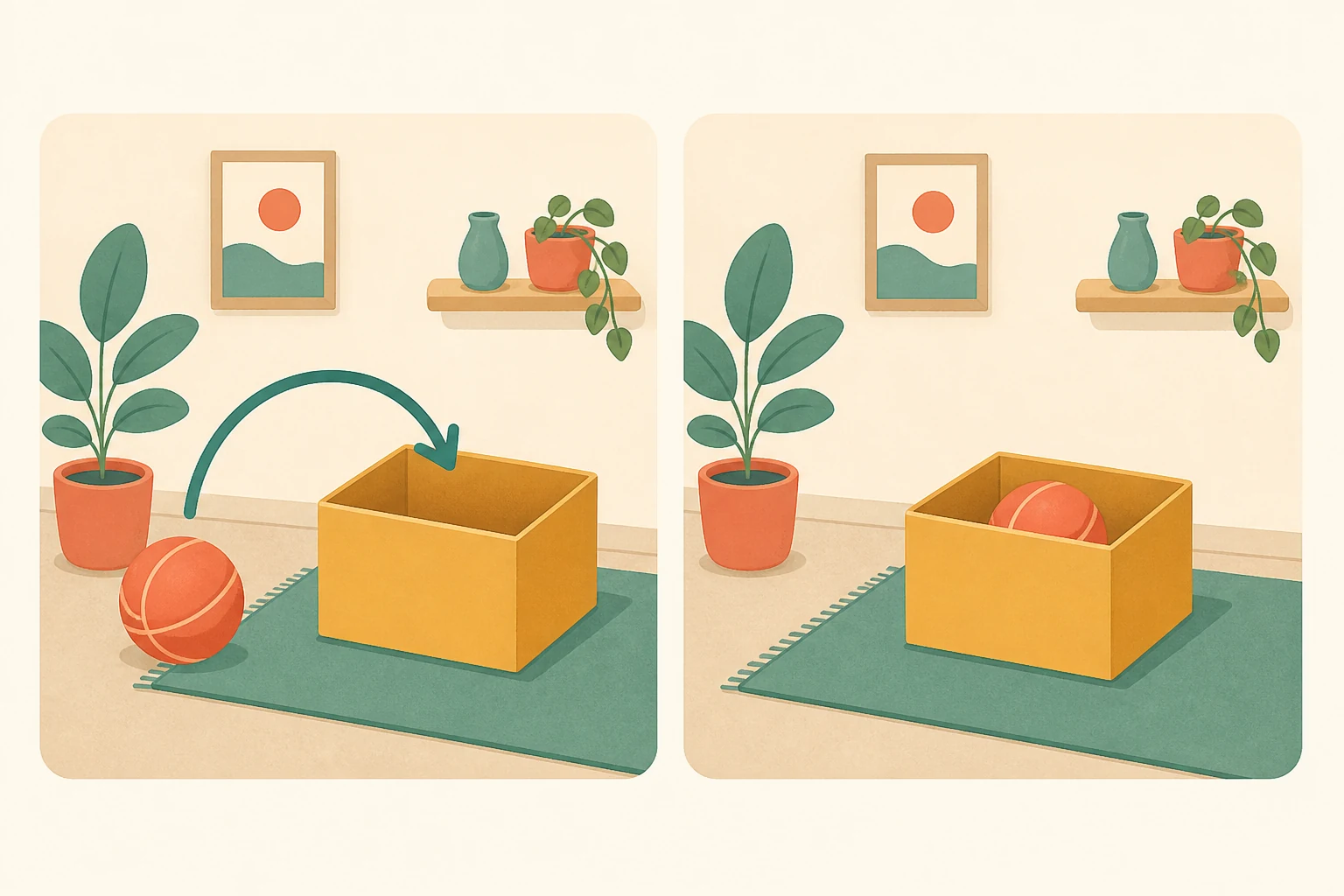
These nine prepositions take the accusative when the construction presents a destination or change into a spatial relation, and the dative when it locates something in an established relation.
The two-way prepositions are an, auf, hinter, in, neben, über, unter, vor and zwischen. They do not always govern one case: the construction's meaning decides. As a practical test, wohin? commonly points to accusative and wo? to dative, but the question is a diagnostic, not a substitute for analysis.
Accusative: Ich stelle die Lampe auf den Tisch presents a change into the position on the table. Dative: Die Lampe steht auf dem Tisch locates the lamp there. Physical movement alone does not trigger accusative: Die Kinder laufen im Park takes dative because the activity occurs within the park and does not present the park as a destination. In Sie laufen in den Park, the park is the goal.
Pairs such as stellen/stehen, legen/liegen, setzen/sitzen and transitive/intransitive hängen make the contrast visible. Nevertheless, case comes from the spatial construction, not from memorising that a verb “is accusative” or “is dative”. The same form hängen can occur in both patterns.
With definite articles, accusative has den/die/das/die and dative dem/der/dem/den. Frequent contractions include ins = in das, im = in dem, ans = an das and am = an dem. A contraction preserves case; it is not an independent form chosen by rote.
Nine prepositions
| Item | Form |
|---|---|
| 1 | an |
| 2 | auf |
| 3 | hinter |
| 4 | in |
| 5 | neben |
| 6 | über |
| 7 | unter |
| 8 | vor |
| 9 | zwischen |
Definite article in the accusative: m, f, n, pl
| Item | Form |
|---|---|
| masculine | den |
| feminine | die |
| neuter | das |
| plural | die |
Definite article in the dative: m, f, n, pl
| Item | Form |
|---|---|
| masculine | dem |
| feminine | der |
| neuter | dem |
| plural | den + noun ending in -n where needed |
Contractions
| Item | Form |
|---|---|
| 1 | in + das = ins (neuter accusative) |
| 2 | in + dem = im (masculine/neuter dative) |
| 3 | an + das = ans (neuter accusative) |
| 4 | an + dem = am (masculine/neuter dative) |
How it sounds
- Der Hund springt auf das Sofa.The sofa is the goal of a change in position: neuter accusative.
- Der Hund schläft auf dem Sofa.The scene locates the dog in an established relation: neuter dative.
- Wir fahren im Tunnel langsam.There is movement, but the tunnel is where it occurs: dative.
Check objective 1Another case
Describe the destination where the newspaper is placed: Timo legt die Zeitung auf ___ Stuhl.
Describe the destination where the newspaper is placed: Timo legt die Zeitung auf ___ Stuhl.
Answer available without interaction
Answer: den — legen presents a change into the position on the chair; masculine accusative is den.
legen presents a change into the position on the chair; masculine accusative is den.
Answer: den — legen presents a change into the position on the chair; masculine accusative is den.
legen presents a change into the position on the chair; masculine accusative is den.
Check objective 2Another case
A proposed answer is “den” for this case: “Die Zeitung liegt auf den Stuhl.”. Choose the only valid form.
A proposed answer is “das” for this case: “Die Zeitung liegt auf das Stuhl.”. Choose the only valid form.
Answer available without interaction
Answer: dem — The sentence locates the Zeitung on the chair; masculine dative is dem.
The sentence locates the Zeitung on the chair; masculine dative is dem.
Answer: dem — The sentence locates the Zeitung on the chair; masculine dative is dem.
The sentence locates the Zeitung on the chair; masculine dative is dem.
Check objective 3Another case
A proposed answer is “in den” for this case: “Die Gäste tanzen in den Saal; der Saal ist nur der Ort der Aktivität.”. Choose the only valid form.
A proposed answer is “ins” for this case: “Die Gäste tanzen ins Saal; der Saal ist nur der Ort der Aktivität.”. Choose the only valid form.
Answer available without interaction
Answer: im — Although movement occurs, Saal is the stable location of the activity: in dem contracts to im.
Although movement occurs, Saal is the stable location of the activity: in dem contracts to im.
Answer: im — Although movement occurs, Saal is the stable location of the activity: in dem contracts to im.
Although movement occurs, Saal is the stable location of the activity: in dem contracts to im.
When it doesn't hold
What breaks the rule, said out loud. Hiding it is what makes you feel cheated in the exam.
- When the preposition is bound to a verb, the case no longer depends on movement: the verb fixes it.Ich freue mich auf das Wochenende.
- The contracted forms are the normal way of speaking, not sloppy shorthand.Wir gehen ins Kino.
- warten auf takes the accusative even though nobody moves, for the same reason.Ich warte auf den Bus.
What your own language pushes you to say
Wrong Ich laufe in den Park jeden Morgen.
Right Ich laufe jeden Morgen im Park.
English separates «into» from «in», which helps, but «run in the park» maps onto both readings and the accusative gets chosen for any sentence that feels energetic.
Challenge: apply every rule
Solve every case and justify each choice: 1) A proposed answer is “dem” for this case: “Timo legt die Zeitung auf dem Stuhl.”. Choose the only valid form. 2) A proposed answer is “den” for this case: “Die Zeitung liegt auf den Stuhl.”. Choose the only valid form. 3) A proposed answer is “in den” for this case: “Die Gäste tanzen in den Saal; der Saal ist nur der Ort der Aktivität.”. Choose the only valid form.
Answer available without interaction
- Recognise the pattern taught in “German two-way prepositions A2” in a short example.
- Choose the appropriate form from “German two-way prepositions A2” using explicit evidence.
- Apply and justify the rule from “German two-way prepositions A2” in a new case.
Answer: den · dem · im
legen presents a change into the position on the chair; masculine accusative is den. The sentence locates the Zeitung on the chair; masculine dative is dem. Although movement occurs, Saal is the stable location of the activity: in dem contracts to im.
Continue along this corridor
Practise this: in, auf, an…: the nine that take two cases depending on wo or wohinGerman preterite A2: sein, haben and modals