

CEFR A2
What you will learn
- Build all six persons of regular imperfect verbs and the three irregular paradigms.
- Use the imperfect for past habits, descriptions, age, time and background actions.
- Contrast an imperfect background with a preterite event that advances the story.
Before you start
- Have studied “The preterite: place a finished event on the timeline”.
The idea
Use the imperfect when the sentence tells what the setting was like, what normally happened, what time it was or what was already in progress. It gives the reader the view from inside the past situation. The tense does not say that an action was unfinished in real life. It simply leaves its boundaries outside the sentence.
All regular “-ar” verbs use “-aba”. Regular “-er” and “-ir” verbs use the same “-ía” family. The written accent remains throughout that second family.
The first and third-person singular forms are identical. A stated subject or the surrounding discourse resolves who is acting when the context does not.
Complete regular imperfect
| person | hablar | comer | vivir |
|---|---|---|---|
| yo | hablaba | comía | vivía |
| tú | hablabas | comías | vivías |
| él / ella / usted | hablaba | comía | vivía |
| nosotros / nosotras | hablábamos | comíamos | vivíamos |
| vosotros / vosotras | hablabais | comíais | vivíais |
| ellos / ellas / ustedes | hablaban | comían | vivían |
The only three irregular imperfect verbs
| person | ser | ir | ver |
|---|---|---|---|
| yo | era | iba | veía |
| tú | eras | ibas | veías |
| él / ella / usted | era | iba | veía |
| nosotros / nosotras | éramos | íbamos | veíamos |
| vosotros / vosotras | erais | ibais | veíais |
| ellos / ellas / ustedes | eran | iban | veían |
How it sounds
- The two tenses express different viewpoints, not different distances from the present.The full market is a state that frames the scene. The music begins at a bounded point and advances the story. Therefore “estaba” is imperfect and “empezó” is preterite.
Check objective 1Another case
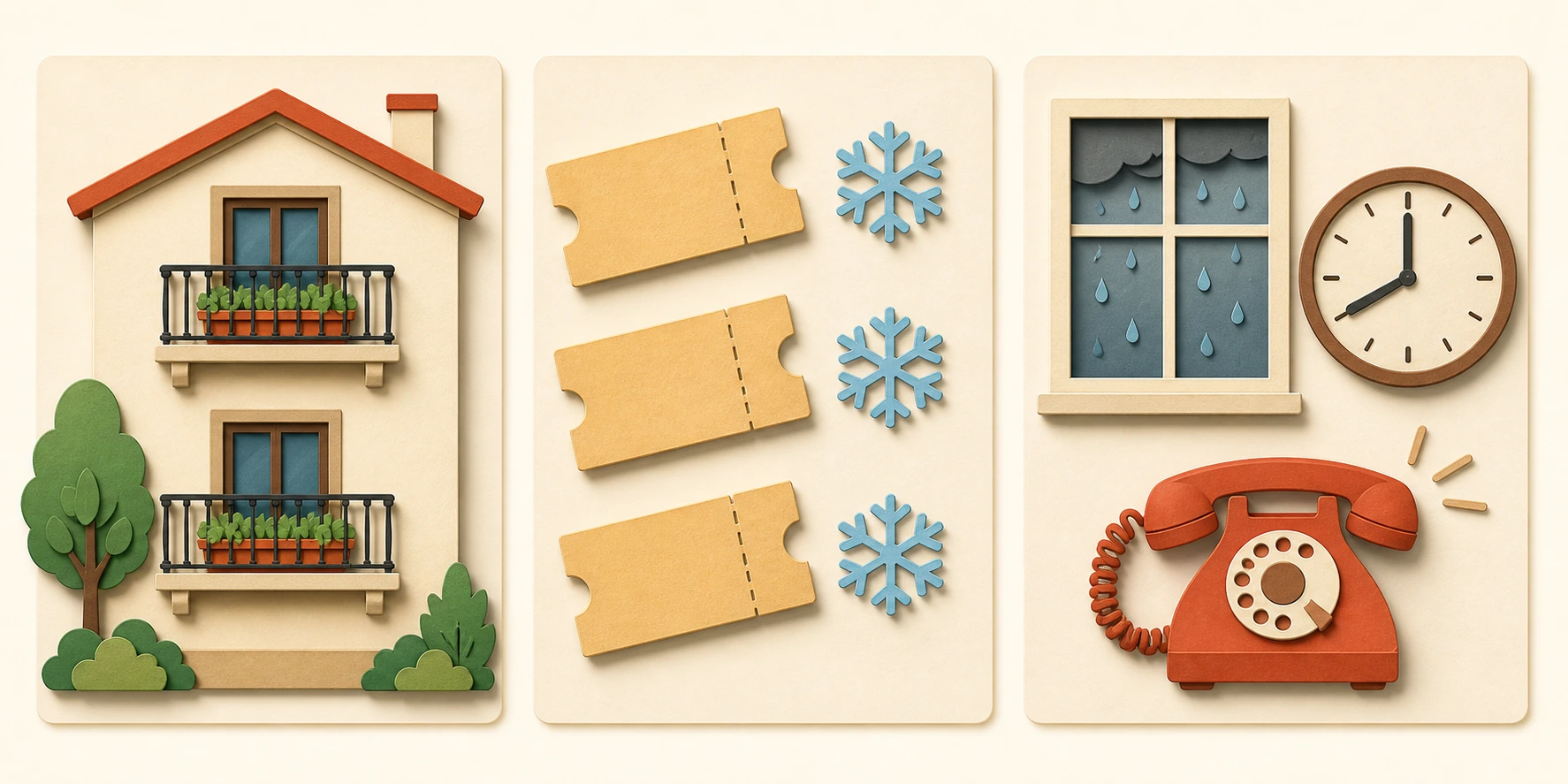
A proposed answer is “viajabamos” for this case: “Use the repeated winter tickets: Todos los inviernos, nosotros viajabamos en tren. (viajar)”. Choose the only valid form.
A proposed answer is “viajábamosnos” for this case: “Use the repeated winter tickets: Todos los inviernos, nosotros viajábamosnos en tren. (viajar)”. Choose the only valid form.
Answer available without interaction
Answer: viajábamos — Todos los inviernos marks a repeated past habit. The “nosotros” imperfect of an “-ar” verb ends in “-ábamos”.
“Todos los inviernos” marks a repeated past habit. The “nosotros” imperfect of an “-ar” verb ends in “-ábamos”.
Answer: viajábamos — Todos los inviernos marks a repeated past habit. The “nosotros” imperfect of an “-ar” verb ends in “-ábamos”.
“Todos los inviernos” marks a repeated past habit. The “nosotros” imperfect of an “-ar” verb ends in “-ábamos”.
Check objective 2Another case
A proposed answer is “tenían” for this case: “Use the house panel as a past description: En 2018, la casa tenían dos balcones. (tener)”. Choose the only valid form.
A proposed answer is “tenia” for this case: “Use the house panel as a past description: En 2018, la casa tenia dos balcones. (tener)”. Choose the only valid form.
Answer available without interaction
Answer: tenía — The balconies describe the house in that past period. “Tener” is regular in the imperfect and takes “-ía”: “tenía”.
The balconies describe the house in that past period. “Tener” is regular in the imperfect and takes “-ía”: “tenía”.
Answer: tenía — The balconies describe the house in that past period. “Tener” is regular in the imperfect and takes “-ía”: “tenía”.
The balconies describe the house in that past period. “Tener” is regular in the imperfect and takes “-ía”: “tenía”.
Check objective 3Another case
The rain was already in progress when the phone rang. Describe that background action: ___ cuando sonó el teléfono. (llover)
The rain was already in progress when the phone rang. Describe that background action: ___ cuando sonó el teléfono. (llover)
Answer available without interaction
Answer: Llovía — The rain is the action already in progress; “sonó” is the bounded event that interrupts it.
The rain is the action already in progress; “sonó” is the bounded event that interrupts it.
Answer: Llovía — The rain is the action already in progress; “sonó” is the bounded event that interrupts it.
The rain is the action already in progress; “sonó” is the bounded event that interrupts it.
What your own language pushes you to say
Wrong De niño fui al parque todos los domingos.
Right De niño iba al parque todos los domingos.
“Todos los domingos” builds a repeated past habit, so the imperfect is the neutral choice.
Challenge: apply every rule
Solve every case and justify each choice: 1) A proposed answer is “tenía” for this case: “Use the repeated winter tickets: Todos los inviernos, nosotros tenía en tren. (viajar)”. Choose the only valid form. 2) A proposed answer is “viajábamos” for this case: “Use the house panel as a past description: En 2018, la casa viajábamos dos balcones. (tener)”. Choose the only valid form. 3) A proposed answer is “Llovió” for this case: “Use the rain, clock and phone panel: Llovió cuando sonó el teléfono. (llover)”. Choose the only valid form.
Answer available without interaction
- Build all six persons of regular imperfect verbs and the three irregular paradigms.
- Use the imperfect for past habits, descriptions, age, time and background actions.
- Contrast an imperfect background with a preterite event that advances the story.
Answer: viajábamos · tenía · Llovía
“Todos los inviernos” marks a repeated past habit. The “nosotros” imperfect of an “-ar” verb ends in “-ábamos”. The balconies describe the house in that past period. “Tener” is regular in the imperfect and takes “-ía”: “tenía”. The rain is the action already in progress; “sonó” is the bounded event that interrupts it.
Curriculum alignment and sources
- A2 simple narration and description support an editorial contrast between event and background. · CEFR descriptors search
- A2 explicitly lists regular imperfect paradigms, ser/ir/ver, description and habitual value. · ic-pcic-grammar-a1-a2
Continue along this corridor
Practise this: “Comí” or “comía”The preterite: place a finished event on the timelineThe present perfect: a past event connected to now