

CEFR A1
What you will learn
- Distinguish common pairs whose spelling changes with an accent, such as ou/où and a/à.
- Use ç before a, o and u to keep the /s/ sound.
Before you start
- Recognise the vocabulary and forms shown in this lesson’s key idea and paradigm.
The idea
The French accent does not mark the stressed syllable: it either changes the sound of the letter or tells apart two words that would otherwise look the same.
Start by unlearning one idea: French tends to stress the last pronounced syllable of a rhythmic group, not a fixed syllable in each word. Written marks do not show that prominence; they have other jobs.
The first, on the “e”, is to change the sound. “é” is closed — “café”, “été”, “mangé” — and “è” and “ê” are open — “père”, “mère”, “fête”. Without the accent the “e” sounds different or does not sound at all: “mange” and “mangé” are not pronounced the same.
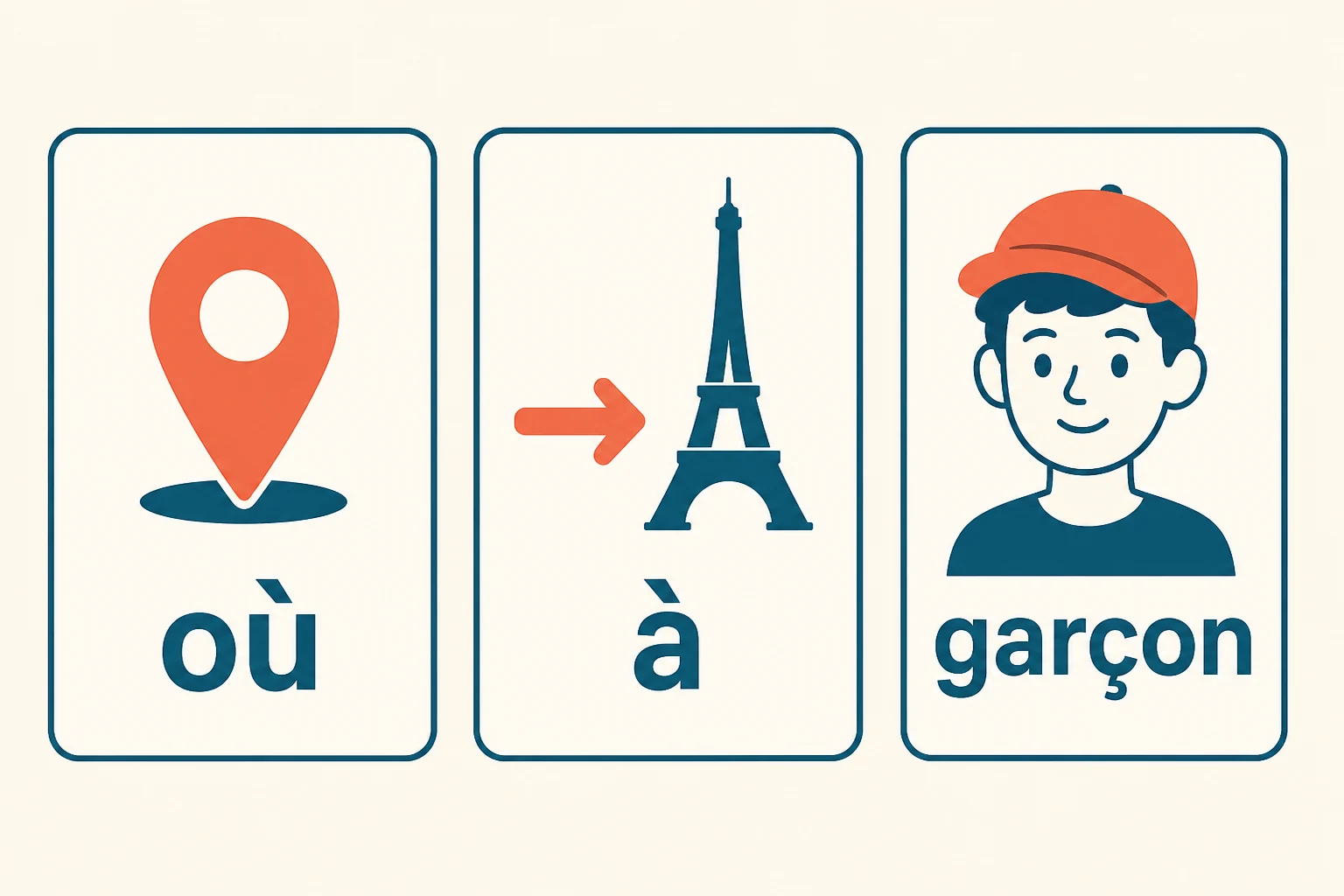
The second job is telling words apart, and there the accent changes no sound at all: it changes only the meaning. “ou” is “or” and “où” is “where”. “a” belongs to the verb and “à” is the preposition. “la” is the article and “là” is “there”. “du” is the partitive and “dû” is a participle. “sur” is “on” and “sûr” is “sure”.
So forgetting an accent in French is not a small spelling slip: very often it is writing a different word, and the sentence stops saying what you meant.
Two more signs. The cedilla makes the “c” sound /s/ before “a”, “o” and “u” — “garçon”, “français”, “ça”; before “e” and “i” it is not needed. And the tréma is two dots saying “this vowel is pronounced separately from the one before”: “Noël”, “naïf”, “maïs”.
Accents and cedilla
| signe | fonction | modèle |
|---|---|---|
| é | voyelle fermée / graphie lexicale | été |
| è / ê | voyelle ouverte / distinction graphique | père / fête |
| à / ù | distinction grammaticale | a / à · ou / où |
| ç | son /s/ devant a, o, u | garçon |
| tréma | voyelles prononcées séparément | Noël |
How it sounds
- J'ai mangé une glace à la vanille.Two accents doing two jobs: “mangé” changes the sound, “à” separates the preposition from the verb.
- Mon père est né à Nice.An open “è” and a closed “é” in one sentence: two different sounds.
- La ville où je vis est petite.Without the accent, “ou” would mean “or” and the sentence would say nothing.
- Le garçon est français.The cedilla before “o” and “a”: without it the sound would be /k/.
Check objective 1Another case
A proposed answer is “ou” for this case: “La ville ou je vis est très petite.”. Choose the only valid form.
A proposed answer is “au” for this case: “La ville au je vis est très petite.”. Choose the only valid form.
Answer available without interaction
Answer: où — Here you need “where”, which is “où”. “Ou” would mean “or”.
Here you need “where”, which is “où”. “Ou” would mean “or”.
Answer: où — Here you need “where”, which is “où”. “Ou” would mean “or”.
Here you need “where”, which is “où”. “Ou” would mean “or”.
Check objective 2Another case
A proposed answer is “garcon” for this case: “Le garcon est très poli avec les clients.”. Choose the only valid form.
A proposed answer is “garzon” for this case: “Le garzon est très poli avec les clients.”. Choose the only valid form.
Answer available without interaction
Answer: garçon — Before “o” you need the cedilla so that the “c” sounds /s/.
Before “o” you need the cedilla so that the “c” sounds /s/.
Answer: garçon — Before “o” you need the cedilla so that the “c” sounds /s/.
Before “o” you need the cedilla so that the “c” sounds /s/.
When it doesn't hold
What breaks the rule, said out loud. Hiding it is what makes you feel cheated in the exam.
- On “a”, “u” and “i” the accent almost never changes the sound: it is only there to tell words apart, which is why most of those letters carry nothing.Un mur, une tortue, il a lu.
- Capitals take accents too. Many people leave them off out of keyboard laziness, and careful writing puts them in.À bientôt ! Église fermée.
What your own language pushes you to say
Wrong Je vais a Paris.
Right Je vais à Paris.
English writes no accents at all, so they look like optional decoration — the sort of thing you drop when typing quickly. In French dropping one usually produces a different word: “a” instead of “à”, “ou” instead of “où”, “sur” instead of “sûr”. It is not untidy, it is wrong.
Challenge: apply both rules
Solve both cases and justify each choice: 1) Una propuesta responde «ou» a este caso: «La ville ou je vis est très petite.». Elige la única forma válida. 2) Una propuesta responde «garcon» a este caso: «Le garcon est très poli avec les clients.». Elige la única forma válida.
Answer available without interaction
- Distinguish common pairs whose spelling changes with an accent, such as ou/où and a/à.
- Use ç before a, o and u to keep the /s/ sound.
Answer: où · garçon
Here you need “where”, which is “où”. “Ou” would mean “or”. Before “o” you need the cedilla so that the “c” sounds /s/.
Curriculum alignment and sources
- CEFR A1 · elementary repertoire for concrete needs and very simple interaction. · Common European Framework of Reference for Languages: Companion Volume
- French-specific descriptions used to cross-check A1 language forms; the page selection remains editorial. · Reference Level Descriptions · French
- MCER como referencia; sin asignación estatal A1 por curso. · Real Decreto 217/2022, currículo básico de ESO
- 7.º ano alcanza A1.2 en este itinerario; A1.1 es subdivisión editorial. · Aprendizagens Essenciais · Francês · 7.º ano
- A1 al final de classe terza; A1.1/A1.2 son subdivisiones editoriales. · Decreto 9 dicembre 2025, n. 221 · nuove Indicazioni nazionali
Continue along this corridor
Practise this: Accents and the cedillaGender and the article: le, la, l', un, uneThe present tense and the explicit subjectTwo-part negation: ne… pas wraps around the verbDu, de la, des: the article your language leaves outAu, aux, du, des: when à and de collide with the articleThe passé composé: two pieces and an auxiliary you have to choose