

CEFR A1
What you will learn
- Put ne or n’ before the verb and pas after it in a basic negative.
- Distinguish pas from rien when negating an action or expressing absence of anything.
Before you start
- Recognise the vocabulary and forms shown in this lesson’s key idea and paradigm.
The idea
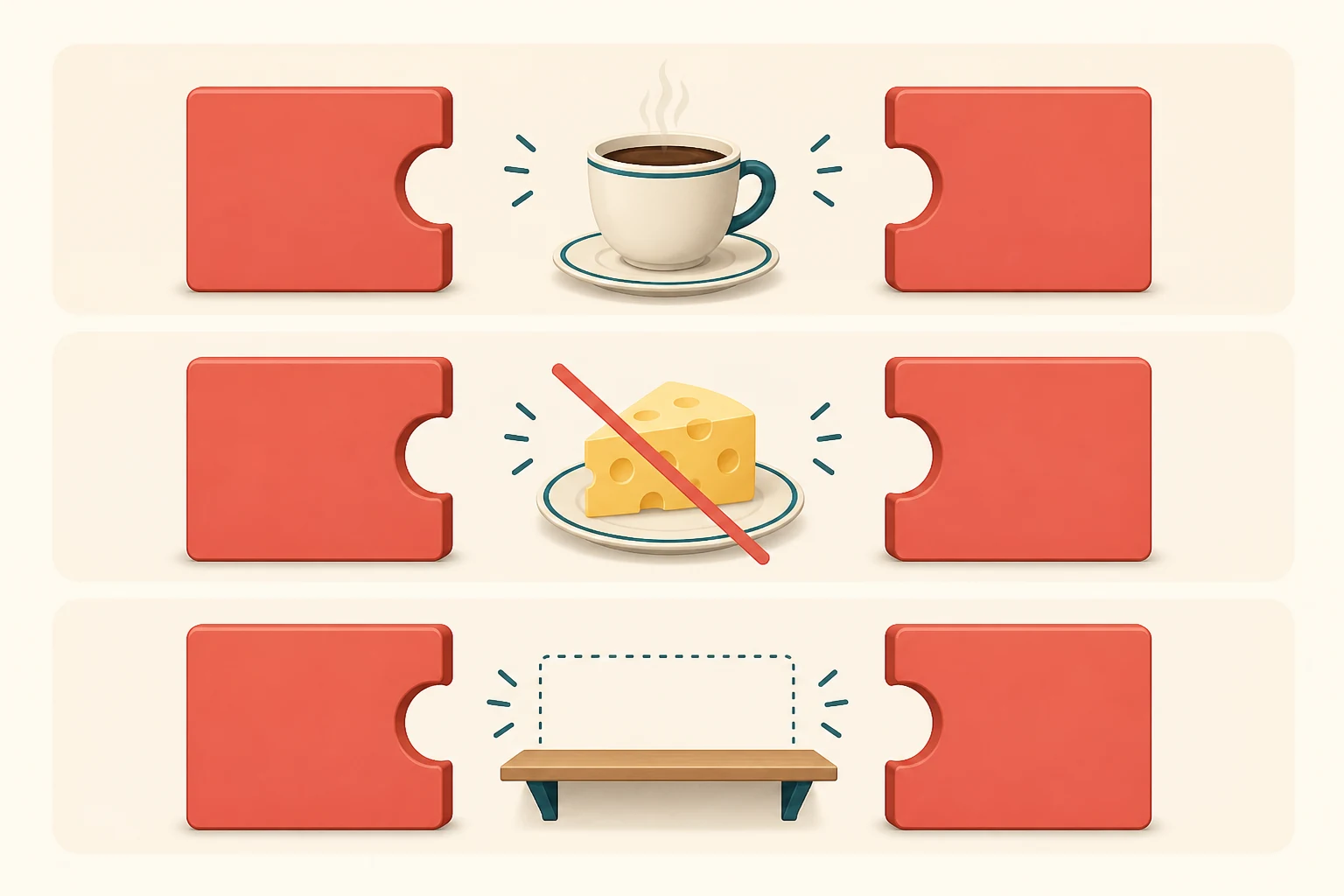
In French the negative is not one word before the verb: it is two, and the verb sits between them.
The front piece is “ne” and it clings to the conjugated verb. The back piece is “pas” and comes straight after it. “Je ne parle pas”: the verb is boxed in between the two.
Before a vowel or a silent “h”, “ne” shortens to “n'”. “Il n'aime pas”, “elle n'habite pas ici”. This is not a stylistic choice: vowel means apostrophe.
The second piece is not always “pas”. Swap it and the meaning changes with nothing else moving: “ne… jamais” is never, “ne… rien” is nothing, “ne… personne” is nobody, “ne… plus” is not any more. The first piece stays “ne” throughout.
Informal speech often drops “ne”, so you may hear “je sais pas”. Keep both parts while learning the structure and in careful writing; recognise omission as an informal spoken feature.
Negation patterns
| Function | Form | Model |
|---|---|---|
| basic | ne + verbe + pas | Je ne parle pas. |
| before vowel | n' + verbe + pas | Je n'écoute pas. |
| nothing | ne + verbe + rien | Je ne vois rien. |
| infinitive | ne pas + infinitif | Ne pas entrer. |
How it sounds
- Je ne parle pas anglais.Both pieces, with the verb inside.
- Il n'aime pas le café.“Aime” starts with a vowel, so “ne” takes an apostrophe.
- Nous ne sortons jamais le lundi.Change the second piece and the sentence goes from “not” to “never”.
- Elle ne mange rien depuis hier.“Rien” already means “nothing”: adding “pas” would negate twice.
Check objective 1Another case
A proposed answer is “n'” for this case: “Je n' comprends pas la question.”. Choose the only valid form.
A proposed answer is “pas” for this case: “Je pas comprends pas la question.”. Choose the only valid form.
Answer available without interaction
Answer: ne — Comprends starts with a consonant, so “ne” stays whole.
“Comprends” starts with a consonant, so “ne” stays whole.
Answer: ne — Comprends starts with a consonant, so “ne” stays whole.
“Comprends” starts with a consonant, so “ne” stays whole.
Check objective 2Another case
Express the complete absence of food consumed in standard written French: Elle ne mange ___ le soir.
Express the complete absence of food consumed in standard written French: Elle ne mange ___ le soir.
Answer available without interaction
Answer: rien — Rien completes ne to express that she consumes no food. Adding pas would negate that absence and change the requested meaning.
“Rien” fills the slot of the second piece. With “pas” in front you would be negating twice.
Answer: rien — Rien completes ne to express that she consumes no food. Adding pas would negate that absence and change the requested meaning.
“Rien” fills the slot of the second piece. With “pas” in front you would be negating twice.
When it doesn't hold
What breaks the rule, said out loud. Hiding it is what makes you feel cheated in the exam.
- Before an infinitive the two pieces stay together and go in front: “ne pas venir”, not one on each side.Il m'a dit de ne pas venir.
- Informal speech often omits “ne”. Careful writing keeps both parts.Je sais pas, moi.
What your own language pushes you to say
Wrong Je ne fais pas parler français.
Right Je ne parle pas français.
You will not forget the second piece, because “not” feels like it. Your problem is the auxiliary: English builds negatives with “do”, and “I do not speak” tempts you into inventing a French “faire”. French needs no helper verb at all — the two pieces go straight around the verb you already have.
Challenge: apply both rules
Solve both cases and justify each choice: 1) Una propuesta responde «n'» a este caso: «Je n' comprends pas la question.». Elige la única forma válida. 2) Una propuesta responde «pas rien» a este caso: «Elle ne mange pas rien le soir.». Elige la única forma válida.
Answer available without interaction
- Put ne or n’ before the verb and pas after it in a basic negative.
- Distinguish pas from rien when negating an action or expressing absence of anything.
Answer: ne · rien
“Comprends” starts with a consonant, so “ne” stays whole. “Rien” fills the slot of the second piece. With “pas” in front you would be negating twice.
Curriculum alignment and sources
- CEFR A1 · elementary repertoire for concrete needs and very simple interaction. · Common European Framework of Reference for Languages: Companion Volume
- French-specific descriptions used to cross-check A1 language forms; the page selection remains editorial. · Reference Level Descriptions · French
- MCER como referencia; sin asignación estatal A1 por curso. · Real Decreto 217/2022, currículo básico de ESO
- 7.º ano alcanza A1.2 en este itinerario; A1.1 es subdivisión editorial. · Aprendizagens Essenciais · Francês · 7.º ano
- A1 al final de classe terza; A1.1/A1.2 son subdivisiones editoriales. · Decreto 9 dicembre 2025, n. 221 · nuove Indicazioni nazionali
Continue along this corridor
Practise this: Negating with ne … pasGender and the article: le, la, l', un, uneThe present tense and the explicit subjectAccents and the cedilla: they do not tell you where the stress fallsDu, de la, des: the article your language leaves outAu, aux, du, des: when à and de collide with the articleThe passé composé: two pieces and an auxiliary you have to choose