

CEFR B1
What you will learn
- Match each degree of reality to its tense pair: present, imperfect or pluperfect after si.
- Distinguish conditional si from interrogative si meaning whether.
Before you start
- Recognise the present, imperfect, pluperfect, future and conditional; identify the clause that introduces a condition.
The idea
In the three patterns studied here, the tense immediately after conditional si helps identify how the speaker presents the condition: open, imagined or past counterfactual.
For a real or open condition, use “si + present”. The result can be present, simple future or imperative according to meaning: “si tu viens, on dîne”; “si tu viens demain, nous sortirons”; “si tu viens, appelle-moi”.
For an imagined present or future situation, use “si + imperfect” and “present conditional”: “si j’avais plus de temps, je lirais davantage”. The imperfect does not place the event in the past here; it marks distance from reality.
For a past condition that can no longer be fulfilled, use “si + pluperfect” and “past conditional”: “si nous avions réservé, nous aurions eu une table”. Both compound tenses place condition and result in an alternative past.
The practical rule is precise: in the three conditional patterns covered here, conditional si meaning “if/in the event that” is not followed by the simple future or conditional. Do not extend that rule to interrogative si meaning “whether”: “je ne sais pas s’il viendra” allows a future because it is not a condition.
These three patterns are a working foundation, not an inventory of every possible combination and nuance in si constructions.
Working paradigm
| Reading | Si-clause | Possible result |
|---|---|---|
| open | si + présent | présent / futur / impératif |
| imagined | si + imparfait | conditionnel présent |
| past counterfactual | si + plus-que-parfait | conditionnel passé |
The result may come first; the tense pairing does not change.
How it sounds
- Si nous avions réservé, nous aurions eu une table.The opportunity has passed. The unfulfilled condition takes the pluperfect: “si nous avions réservé”. The alternative result takes the past conditional: “nous aurions eu”.
- Je ne sais pas si Léa viendra demain.The direct question calls for a yes/no answer. Je ne sais pas turns it into an indirect question. Here si means whether, so the future viendra remains.
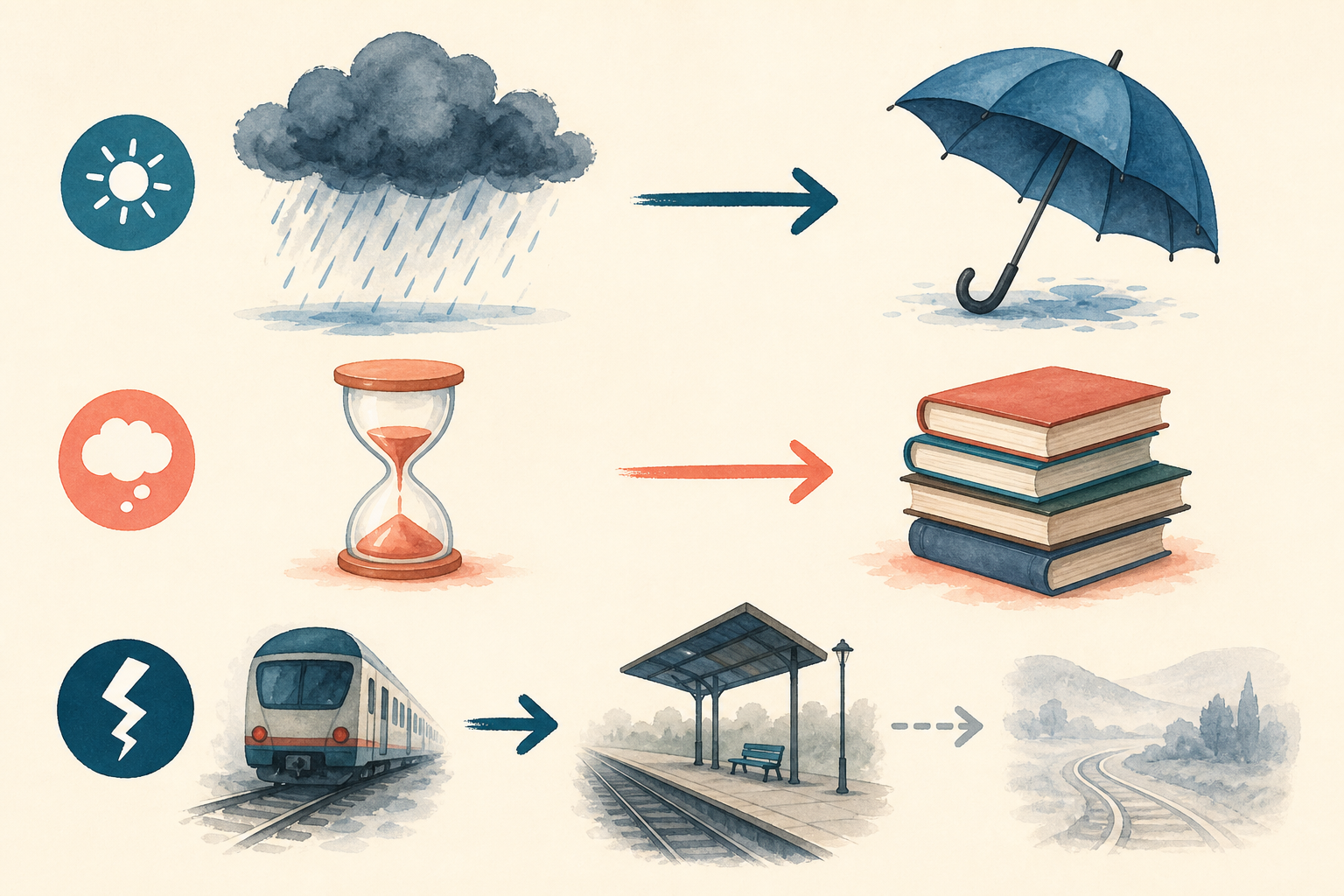
Match each situation to its patternTry another case
Match each complete sentence to the reading and tense pair it demonstrates.
New sentences: match each condition to its full pattern again.
Answer available without interaction
Answer: Si tu as faim, prends une pomme. → open · si + présent → impératif; Si j’étais libre demain, je viendrais avec vous. → imagined · si + imparfait → conditionnel présent; Si nous avions réservé, nous aurions eu une table. → past counterfactual · si + plus-que-parfait → conditionnel passé
The full tense pair, not one isolated word, determines all three matches.
Answer: Si vous arrivez tôt, nous visiterons le jardin. → open · présent → futur simple; Si elle connaissait la réponse, elle nous la dirait. → imagined · imparfait → conditionnel présent; S’ils avaient pris le train, ils seraient arrivés à l’heure. → past counterfactual · plus-que-parfait → conditionnel passé
The retry changes all three situations and the specific result used by the open condition.
Spot the analysis that confuses two uses of siTry another case
A learner analyses “Je ne sais pas si Léa viendra demain”. Identify the only faulty step and choose its correction.
Now analyse “Dis-moi si tu pourras venir samedi”. Identify the only faulty step and correct it.
Answer available without interaction
Answer: Because si appears, viendra must be replaced by vient. → Keep viendra: interrogative si allows the future.
The future viendra is correct because si introduces an indirect whether-question here.
Answer: Because it is interrogative, si prohibits the future pourras. → Keep pourras: the restriction does not apply to interrogative si.
Pourras remains: the speaker asks about a future possibility through interrogative si.
When it doesn't hold
What breaks the rule, said out loud. Hiding it is what makes you feel cheated in the exam.
- ConditionS’il vient demain, nous sortirons.
- Indirect questionJe ne sais pas s’il viendra demain.
What your own language pushes you to say
Wrong Si j’aurais plus de temps, je voyagerais.
Right Si j’avais plus de temps, je voyagerais.
The conditional belongs in the imagined result; the condition uses the imperfect. Non-standard patterns in other languages may suggest “si j’aurais”, but the French pair is fixed.
Challenge: three conditions and one question
Complete and justify: “Si tu ___ (avoir) le temps, appelle-moi”; “Si j’___ (être) libre, je viendrais”; “Si nous ___ (partir) plus tôt, nous aurions pris le train”; “Je ne sais pas si elle ___ (venir) demain”.
Answer available without interaction
- Use the present before the imperative result.
- Use the imperfect with the present conditional and the pluperfect with the past conditional.
- Identify interrogative si before deciding whether the future is possible.
Answer: as · étais · étions partis · viendra
The first three sentences use present, imperfect and pluperfect after si; the fourth keeps the future because si introduces an indirect question.
Curriculum alignment and sources
- CEFR B1 · understand the main points of clear messages on familiar matters, handle common situations and produce simple connected text. · Common European Framework of Reference for Languages: Companion Volume
- French-specific reference descriptions used to cross-check B1 forms; they are not a universal school curriculum. · Reference Level Descriptions · French
- El MCER sirve de referencia, pero la norma estatal no asigna B1.1/B1.2 a cursos. La secuencia del catálogo es editorial. · Real Decreto 217/2022, currículo básico de ESO
- Las fuentes oficiales distinguen recorridos. Este paquete no publica una equivalencia universal B1→ano. · Organização curricular · Francês · iniciação e continuação
- La fuente reutilizada fija A1 al final del primer ciclo para esta materia y no acredita B1 en un curso italiano concreto. · Decreto 9 dicembre 2025, n. 221 · nuove Indicazioni nazionali
Continue along this corridor
Practise this: After si, never the futureFrench subjunctive: forms, triggers and contrast with the indicativePast participle agreement: auxiliary, object and positionReported speech: person, tense and viewpointOn and the passive: choosing sentence focusSpoken and written French: adapting register