

CEFR B1
What you will learn
- Recognise the pattern taught in “als, wenn or wann: German's three ways of saying when” in a short example.
- Choose the appropriate form from “als, wenn or wann: German's three ways of saying when” using explicit evidence.
- Apply and justify the rule from “als, wenn or wann: German's three ways of saying when” in a new case.
Before you start
- Have studied “German subordinate clauses A2: finite verb last”.
The idea
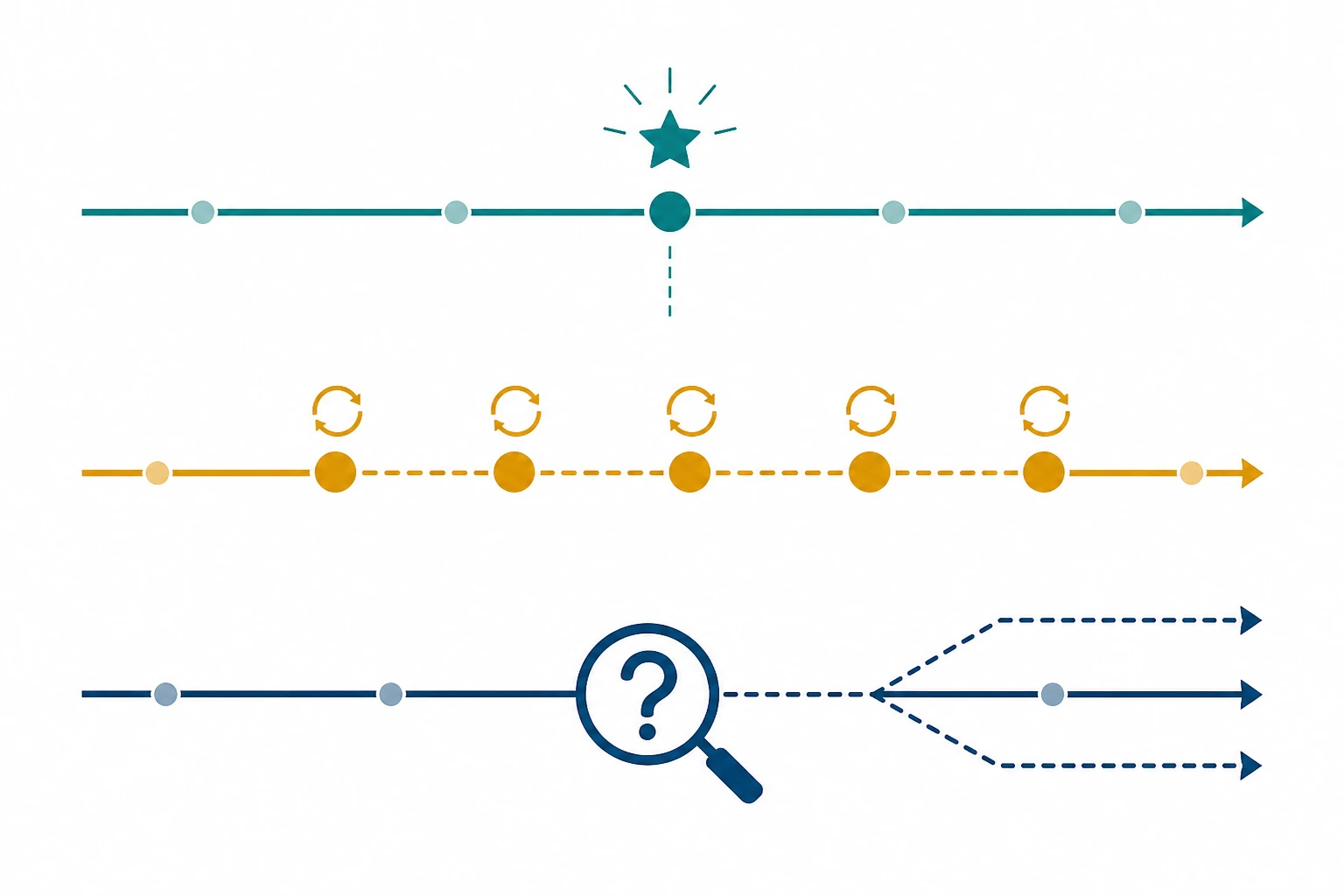
In this temporal contrast, wann keeps interrogative force, als locates a non-repeated past frame, and wenn presents repetition, present or future time, or a condition. Translation alone cannot choose the form.
Two questions guide this contrast. First: does the expression ask about the time, directly or indirectly? If it does, use wann: «Wann kommst du?», «Ich weiß nicht, wann er kommt».
If there is no interrogative force, ask whether the connector opens a past time frame presented as non-repeated. If so, use als: «Als ich klein war, wohnten wir in Bonn». The frame may last for some time; what matters is that it is not presented as a series of occasions.
wenn serves for repeated temporal relations, present or future reference, and conditions: «Wenn ich Zeit habe, lese ich», «Immer wenn er kam, brachte er Blumen». In the past, the relevant contrast is a non-iterative frame with als versus an iterative series with wenn; immer reinforces the repeated reading in the second example.
Word order is a separate decision. als, wenn and the wann of an indirect question open subordinate clauses and place the finite form at the end. The wann of a direct question does not open a subordinate clause: the finite verb follows it, as in «Wann kommst du?».
Thus wann keeps interrogative force; als and wenn work as temporal connectors, and wenn can also express a condition. The same translation can hide different functions, so check interrogative force, iteration and word order.
Choosing between als, wenn and wann
| Item | Form |
|---|---|
| 1 | direct question · wann · verb in second position · Wann beginnt der Kurs? |
| 2 | indirect question · wann · verb at the end · Ich weiß nicht, wann der Kurs beginnt. |
| 3 | single occasion in the past · als · verb at the end · Als der Zug ankam, regnete es. |
| 4 | repeated occasions · wenn · verb at the end · Immer wenn wir kamen, war er da. |
| 5 | present/future or condition · wenn · verb at the end · Wenn ich Zeit habe, komme ich. |
How it sounds
- Wann kommst du nach Hause?Direct question: wann, with the verb right after.
- Ich weiß nicht, wann er kommt.Indirect question: still wann, and the verb goes to the end.
- Als ich klein war, wohnten wir in Bonn.Once, in the past: als.
- Immer wenn er kam, brachte er Blumen.Past but repeated, and with immer in front: wenn.
Check objective 1Another case
A proposed answer is “Wenn” for this case: “Bilde den einmaligen Zeitrahmen in der Vergangenheit: Wenn der Zug gestern ankam, begann es zu schneien.”. Choose the only valid form.
A proposed answer is “Wann” for this case: “Bilde den einmaligen Zeitrahmen in der Vergangenheit: Wann der Zug gestern ankam, begann es zu schneien.”. Choose the only valid form.
Answer available without interaction
Answer: Als — This is a single arrival located in the past: als.
This is a single arrival located in the past: als.
Answer: Als — This is a single arrival located in the past: als.
This is a single arrival located in the past: als.
Check objective 2Another case
A proposed answer is “als” for this case: “Weißt du, als der Kurs beginnt?”. Choose the only valid form.
A proposed answer is “wenn” for this case: “Weißt du, wenn der Kurs beginnt?”. Choose the only valid form.
Answer available without interaction
Answer: wann — The subordinate clause contains a question about time, so it uses wann and ends in beginnt.
The subordinate clause contains a question about time, so it uses wann and ends in beginnt.
Answer: wann — The subordinate clause contains a question about time, so it uses wann and ends in beginnt.
The subordinate clause contains a question about time, so it uses wann and ends in beginnt.
Check objective 3Another case
A proposed answer is “wann” for this case: “Immer wann wir in Köln waren, besuchten wir das Museum.”. Choose the only valid form.
A proposed answer is “als” for this case: “Immer als wir in Köln waren, besuchten wir das Museum.”. Choose the only valid form.
Answer available without interaction
Answer: wenn — immer marks repetition in the past; the temporal conjunction is wenn.
immer marks repetition in the past; the temporal conjunction is wenn.
Answer: wenn — immer marks repetition in the past; the temporal conjunction is wenn.
immer marks repetition in the past; the temporal conjunction is wenn.
When it doesn't hold
What breaks the rule, said out loud. Hiding it is what makes you feel cheated in the exam.
- wenn also introduces a condition, and there it is not about time.Wenn es regnet, bleiben wir zu Hause.
- als has another job: comparing, in the sense of than.Er ist größer als ich.
- wenn can be dropped, and then the clause starts with the verb.Hast du Zeit, komm vorbei.
What your own language pushes you to say
Wrong When ich klein war…
Right Als ich klein war…
English has one word for all three uses, and when maps onto wenn by sound, so the past narrative als never gets picked. The English when of a single past event is als and nothing else.
Challenge: apply every rule
Solve every case and justify each choice: 1) A proposed answer is “Wenn” for this case: “Bilde den einmaligen Zeitrahmen in der Vergangenheit: Wenn der Zug gestern ankam, begann es zu schneien.”. Choose the only valid form. 2) A proposed answer is “als” for this case: “Weißt du, als der Kurs beginnt?”. Choose the only valid form. 3) A proposed answer is “wann” for this case: “Immer wann wir in Köln waren, besuchten wir das Museum.”. Choose the only valid form.
Answer available without interaction
- Recognise the pattern taught in “als, wenn or wann: German's three ways of saying when” in a short example.
- Choose the appropriate form from “als, wenn or wann: German's three ways of saying when” using explicit evidence.
- Apply and justify the rule from “als, wenn or wann: German's three ways of saying when” in a new case.
Answer: Als · wann · wenn
This is a single arrival located in the past: als. The subordinate clause contains a question about time, so it uses wann and ends in beginnt. immer marks repetition in the past; the temporal conjunction is wenn.
Continue along this corridor
Practise this: als, wenn or wann: German's three ways of saying «when»Konjunktiv II: what is not true and what you ask for politely