

CEFR B1
What you will learn
- Recognise the pattern taught in “The zu-infinitive, and um…zu for purpose” in a short example.
- Choose the appropriate form from “The zu-infinitive, and um…zu for purpose” using explicit evidence.
- Apply and justify the rule from “The zu-infinitive, and um…zu for purpose” in a new case.
Before you start
- Recognise the vocabulary and forms shown in this lesson’s key idea and paradigm.
The idea
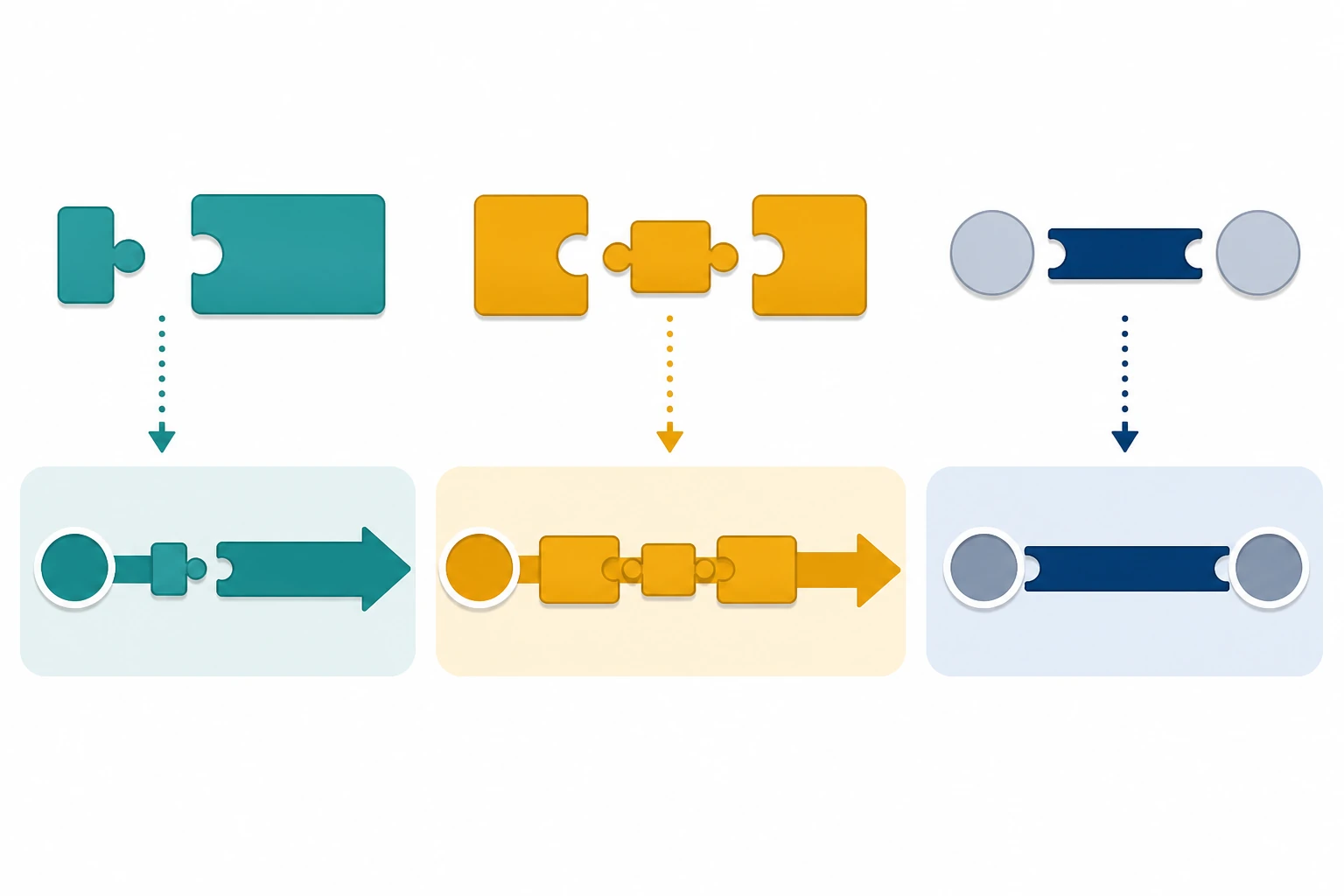
Many German verbs and expressions link to a zu-infinitive, whose placement depends on whether the verb is simple, separable or inseparable. With um…zu, the construction expresses purpose and normally shares its subject with the main clause.
The basic model is «Ich versuche, früher aufzustehen». Before a simple or inseparable infinitive, zu stays separate: zu kommen, zu besuchen, zu studieren. With a separable verb, it sits between the prefix and base: aufzustehen, mitzukommen, anzurufen.
Verbs such as versuchen, vergessen, anfangen, aufhören, hoffen or beschließen select this construction, as do expressions with sein or haben: «Es ist wichtig, pünktlich zu sein», «Ich habe keine Lust, heute zu kochen». Learn the pattern with the expression that governs it.
um…zu expresses purpose when the construction’s implicit subject normally matches the main-clause subject: «Ich lerne Deutsch, um in Wien zu studieren». damit permits a different explicit subject and can also occur with the same subject; when the subjects have to differ, um…zu is not available.
ohne…zu presents an action that does not take place —«Er ging weg, ohne etwas zu sagen»— and statt…zu an alternative. A finite modal governs a bare infinitive: «Ich muss arbeiten». The modal itself can nevertheless carry zu inside another construction: «ohne arbeiten zu müssen». Thus the absence of zu concerns the infinitive governed directly by the modal, not every occurrence of a modal.
The 2024 Official Rules of German Spelling treat sentence-valued infinitive groups as infinitive subordinate clauses and delimit them with a comma, with or without an introducer: «Ich hoffe, bald zu kommen». Exceptions cover non-clausal readings or forms integrated into the verbal group (§ 73 E2/E4), such as «Er scheint zu schlafen»; first decide whether the group functions as an infinitive subordinate clause.
An infinitive construction does not express a nominative subject of its own; that subject is recovered from the main clause or context. To solve one, identify the governor, recovered subject, function —complement, purpose, absence or substitution— and lexical verb type before placing zu.
Position of zu
| Item | Form |
|---|---|
| 1 | simple · kommen · zu kommen |
| 2 | separable · anfangen · anzufangen |
| 3 | separable · aufstehen · aufzustehen |
| 4 | inseparable · besuchen · zu besuchen |
| 5 | ending in -ieren · studieren · zu studieren |
Verb government and purpose
| Item | Form |
|---|---|
| 1 | verb that takes zu · Ich hoffe, bald zu kommen. |
| 2 | modal without zu · Ich muss heute arbeiten. |
| 3 | modal inside another zu group · ohne arbeiten zu müssen |
| 4 | same subject, purpose · Sie spart, um zu reisen. |
| 5 | different subjects, purpose · Ich erkläre es, damit du es verstehst. |
Commas with infinitive groups
| Item | Form |
|---|---|
| 1 | infinitive clause with an introductory word · Er ging, ohne zu warten. |
| 2 | infinitive clause dependent on a verb · Ich hoffe, bald zu kommen. |
| 3 | embedded infinitive clause · Sein Wunsch, zu reisen, wurde stärker. |
| 4 | reading integrated into the verb group · Er scheint zu schlafen. · exception: no comma |
How it sounds
- Ich versuche, früher aufzustehen.Separable verb: the zu goes between the prefix and the stem.
- Ich lerne Deutsch, um in Wien zu studieren.Same subject in both halves, so um…zu fits.
- Er ging weg, ohne etwas zu sagen.ohne…zu says what did not happen, in two words.
- Ich muss heute länger arbeiten.In this finite-modal group, the directly governed infinitive has no zu.
Check objective 1Another case
A proposed answer is “sehen” for this case: “Ich hoffe, dich bald sehen. (sehen)”. Choose the only valid form.
A proposed answer is “zu sieht” for this case: “Ich hoffe, dich bald zu sieht. (sehen)”. Choose the only valid form.
Answer available without interaction
Answer: zu sehen — The verb hoffen introduces a zu-infinitive construction; the simple verb gives zu sehen.
hoffen introduces a zu-infinitive construction; the simple verb gives zu sehen.
Answer: zu sehen — The verb hoffen introduces a zu-infinitive construction; the simple verb gives zu sehen.
hoffen introduces a zu-infinitive construction; the simple verb gives zu sehen.
Check objective 2Another case
A proposed answer is “zu einkaufen” for this case: “Wir versuchen, morgen früher zu einkaufen. (einkaufen)”. Choose the only valid form.
A proposed answer is “einkaufen” for this case: “Wir versuchen, morgen früher einkaufen. (einkaufen)”. Choose the only valid form.
Answer available without interaction
Answer: einzukaufen — The verb einkaufen is separable, so zu is inserted between ein and kaufen.
einkaufen is separable, so zu is inserted between ein and kaufen.
Answer: einzukaufen — The verb einkaufen is separable, so zu is inserted between ein and kaufen.
einkaufen is separable, so zu is inserted between ein and kaufen.
Check objective 3Another case
A proposed answer is “damit” for this case: “Sie spart Geld, damit im Sommer zu reisen.”. Choose the only valid form.
A proposed answer is “ob” for this case: “Sie spart Geld, ob im Sommer zu reisen.”. Choose the only valid form.
Answer available without interaction
Answer: um — The subject of saving and travelling is the same, so purpose is expressed with um…zu.
The subject of saving and travelling is the same, so purpose is expressed with um…zu.
Answer: um — The subject of saving and travelling is the same, so purpose is expressed with um…zu.
The subject of saving and travelling is the same, so purpose is expressed with um…zu.
When it doesn't hold
What breaks the rule, said out loud. Hiding it is what makes you feel cheated in the exam.
- sehen, hören, lassen, gehen and bleiben link without zu.Ich sehe ihn kommen.
- If the second half has a different subject, um…zu will not do and damit is needed.Ich lerne Deutsch, damit meine Kinder mich verstehen.
- With sein plus zu plus infinitive the sentence turns into a passive of possibility.Das ist leicht zu verstehen.
What your own language pushes you to say
Wrong Ich hoffe zu sehen dich bald.
Right Ich hoffe, dich bald zu sehen.
English puts «to see» right after the verb and everything else afterwards. German sends the zu-infinitive to the very end, so the object and the time have to go in front of it.
Challenge: apply every rule
Solve every case and justify each choice: 1) A proposed answer is “einzukaufen” for this case: “Ich hoffe, dich bald einzukaufen. (sehen)”. Choose the only valid form. 2) A proposed answer is “zu sehen” for this case: “Wir versuchen, morgen früher zu sehen. (einkaufen)”. Choose the only valid form. 3) A proposed answer is “damit” for this case: “Sie spart Geld, damit im Sommer zu reisen.”. Choose the only valid form.
Answer available without interaction
- Recognise the pattern taught in “The zu-infinitive, and um…zu for purpose” in a short example.
- Choose the appropriate form from “The zu-infinitive, and um…zu for purpose” using explicit evidence.
- Apply and justify the rule from “The zu-infinitive, and um…zu for purpose” in a new case.
Answer: zu sehen · einzukaufen · um
hoffen introduces a zu-infinitive construction; the simple verb gives zu sehen. einkaufen is separable, so zu is inserted between ein and kaufen. The subject of saving and travelling is the same, so purpose is expressed with um…zu.
Continue along this corridor
Practise this: The infinitive with zu: when it goes in and when it does notThe passive with werden: when what matters is the deed, not the doer