

CEFR A1
What you will learn
- Recognise the pattern taught in “German plurals: five patterns and vowel change” in a short example.
- Choose the appropriate form from “German plurals: five patterns and vowel change” using explicit evidence.
- Apply and justify the rule from “German plurals: five patterns and vowel change” in a new case.
Before you start
- Recognise the vocabulary and forms shown in this lesson’s key idea and paradigm.
The idea
There is no single plural ending: store each noun as article + singular + plural and use patterns to organize, not to guess without checking.
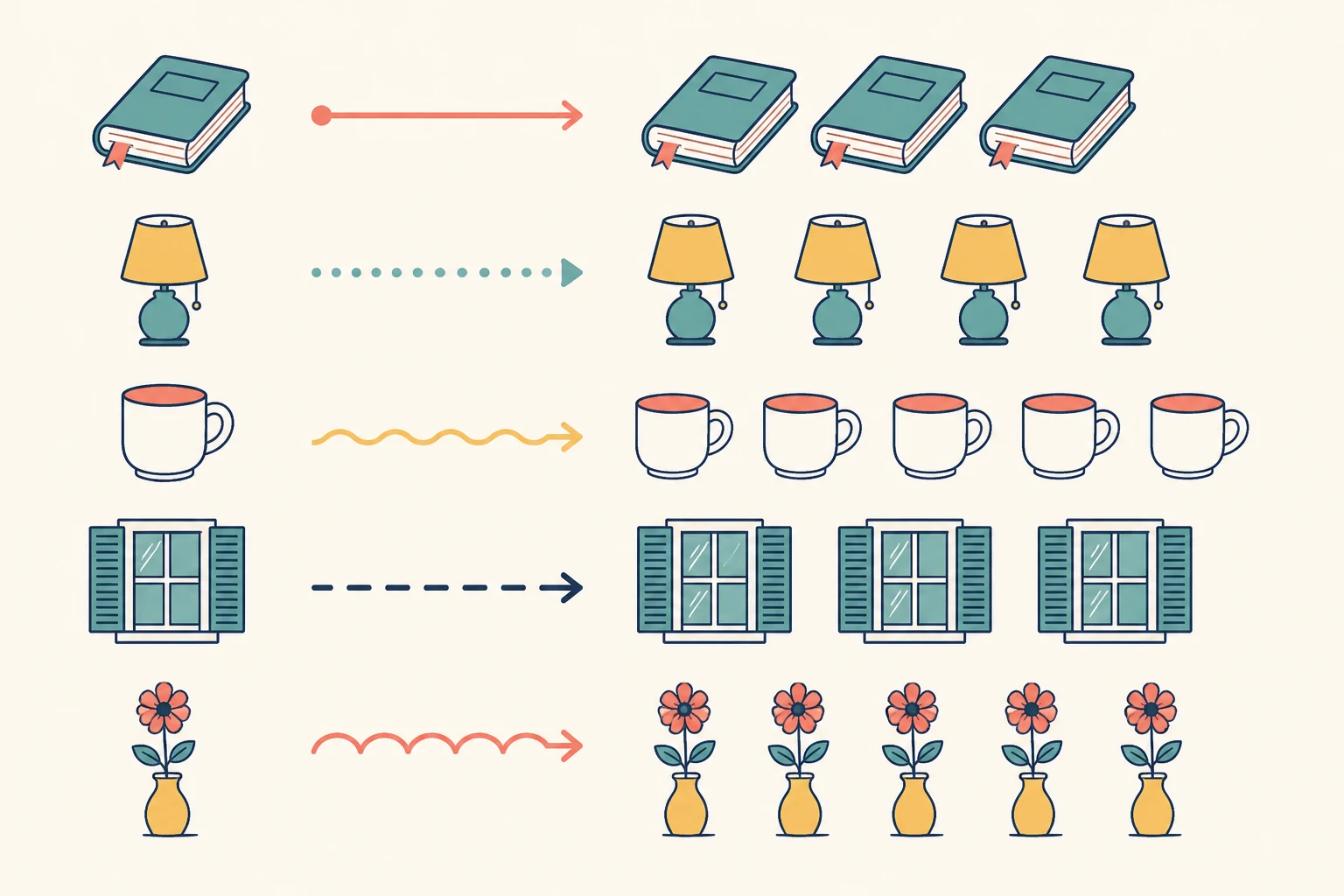
The five main visible outcomes are -e, -(e)n, -er, -s and a zero-ending plural. A vowel change—a→ä, o→ö, u→ü, au→äu—may accompany -e, -er or the zero ending; it is not a sixth independent ending.
The -(e)n pattern is very frequent with feminine nouns and especially reliable in derivations such as -ung, -heit, -keit and -schaft: die Rechnung → die Rechnungen. Not every feminine uses it: die Hand → die Hände. -s is productive with many loans, abbreviations and vowel-final words: das Foto → die Fotos, but it does not make every loanword an -s plural.
-e appears with many masculine and neuter nouns and sometimes adds an umlaut; -er appears with a set of neuter and some masculine nouns, with an umlaut when the vowel allows it; a zero-ending plural is common with several nouns in -er, -el and -en, but the vowel may change. These are tendencies, not rules that can manufacture every plural.
In the nominative and accusative plural, the definite article is always die. The indefinite article has no plural. Learn the complete card when adding vocabulary: der Stuhl, die Stühle; do not store only Stuhl = chair.
Plural patterns
| Item | Form |
|---|---|
| 1 | -e |
| 2 | -(e)n |
| 3 | -er |
| 4 | -s |
| 5 | no suffix |
Possible vowel change
| Item | Form |
|---|---|
| 1 | a → ä |
| 2 | o → ö |
| 3 | u → ü |
| 4 | au → äu |
How it sounds
- der Tag → die Tage · die Nacht → die NächteBoth use -e; the second also adds an umlaut.
- die Frau → die Frauen · das Kind → die KinderTwo different patterns: -(e)n and -er.
- das Auto → die Autos · der Vater → die Väter-s versus a zero-ending plural with an umlaut.
Check objective 1Another case
A proposed answer is “Wohnunge” for this case: “die Wohnung → die Wohnunge”. Choose the only valid form.
A proposed answer is “Wohnungs” for this case: “die Wohnung → die Wohnungs”. Choose the only valid form.
Answer available without interaction
Answer: Wohnungen — Nouns derived in -ung reliably form the plural in -en: Wohnungen.
Nouns derived in -ung reliably form the plural in -en: Wohnungen.
Answer: Wohnungen — Nouns derived in -ung reliably form the plural in -en: Wohnungen.
Nouns derived in -ung reliably form the plural in -en: Wohnungen.
Check objective 2Another case
A proposed answer is “Hotelen” for this case: “das Hotel → die Hotelen”. Choose the only valid form.
A proposed answer is “Hötel” for this case: “das Hotel → die Hötel”. Choose the only valid form.
Answer available without interaction
Answer: Hotels — Hotel is an established loanword with an -s plural: Hotels.
Hotel is an established loanword with an -s plural: Hotels.
Answer: Hotels — Hotel is an established loanword with an -s plural: Hotels.
Hotel is an established loanword with an -s plural: Hotels.
Check objective 3Another case
A proposed answer is “Apfeln” for this case: “der Apfel → die Apfeln”. Choose the only valid form.
A proposed answer is “Apfels” for this case: “der Apfel → die Apfels”. Choose the only valid form.
Answer available without interaction
Answer: Äpfel — Apfel uses a zero-ending plural and changes a to ä: Äpfel.
Apfel uses a zero-ending plural and changes a to ä: Äpfel.
Answer: Äpfel — Apfel uses a zero-ending plural and changes a to ä: Äpfel.
Apfel uses a zero-ending plural and changes a to ä: Äpfel.
When it doesn't hold
What breaks the rule, said out loud. Hiding it is what makes you feel cheated in the exam.
- Words of Latin or Greek origin keep their learned plural.die Praktika, die Themen, die Museen
- A few words exist only in the plural and have no singular to learn.die Eltern, die Leute, die Ferien
- Bank has two plurals, one for the bench and one for the financial institution: here the plural separates the meanings.die Bank – die Bänke / die Banken
What your own language pushes you to say
Wrong Zwei Frau warten draußen.
Right Zwei Frauen warten draußen.
English marks the plural once and then forgets about it, so after a number the noun often gets left in the singular. German marks it every single time, number or no number.
Challenge: apply every rule
Solve every case and justify each choice: 1) A proposed answer is “Wohnunge” for this case: “die Wohnung → die Wohnunge”. Choose the only valid form. 2) A proposed answer is “Hotelen” for this case: “das Hotel → die Hotelen”. Choose the only valid form. 3) A proposed answer is “Apfeln” for this case: “der Apfel → die Apfeln”. Choose the only valid form.
Answer available without interaction
- Recognise the pattern taught in “German plurals: five patterns and vowel change” in a short example.
- Choose the appropriate form from “German plurals: five patterns and vowel change” using explicit evidence.
- Apply and justify the rule from “German plurals: five patterns and vowel change” in a new case.
Answer: Wohnungen · Hotels · Äpfel
Nouns derived in -ung reliably form the plural in -en: Wohnungen. Hotel is an established loanword with an -s plural: Hotels. Apfel uses a zero-ending plural and changes a to ä: Äpfel.
Curriculum alignment and sources
- CEFR A1 · elementary noun repertoire for people and concrete objects; the plural classification is editorial · Common European Framework of Reference for Languages: Companion Volume
- German noun morphology cross-checked against language-specific reference descriptions · Reference Level Descriptions developed so far
Continue along this corridor
Practise this: The plural is not an -s: the five routesSeparable verbs in the present: the sentence bracket