

CEFR B1
What you will learn
- Recognise the pattern taught in “Reflexive verbs: sich, and the mich that is sometimes mir” in a short example.
- Choose the appropriate form from “Reflexive verbs: sich, and the mich that is sometimes mir” using explicit evidence.
- Apply and justify the rule from “Reflexive verbs: sich, and the mich that is sometimes mir” in a new case.
Before you start
- Have studied “German dative A2: forms, functions and government”.
The idea
In a reflexive construction, the pronoun agrees with the person. It is commonly accusative; in patterns such as washing a body part, the explicit object occupies the accusative and the pronoun appears in the dative.
Frequent constructions include sich freuen, sich interessieren, sich erinnern, sich waschen, sich anziehen, sich setzen, sich fühlen, sich beeilen, sich entschuldigen, sich vorstellen, sich treffen and sich ärgern. Some require a reflexive in a particular meaning; others also have non-reflexive uses that must be learnt separately.
The pronoun changes with the person: ich freue mich, du freust dich, er freut sich, wir freuen uns, ihr freut euch, sie freuen sich. Third person and the polite form use sich; the other persons have dedicated forms.
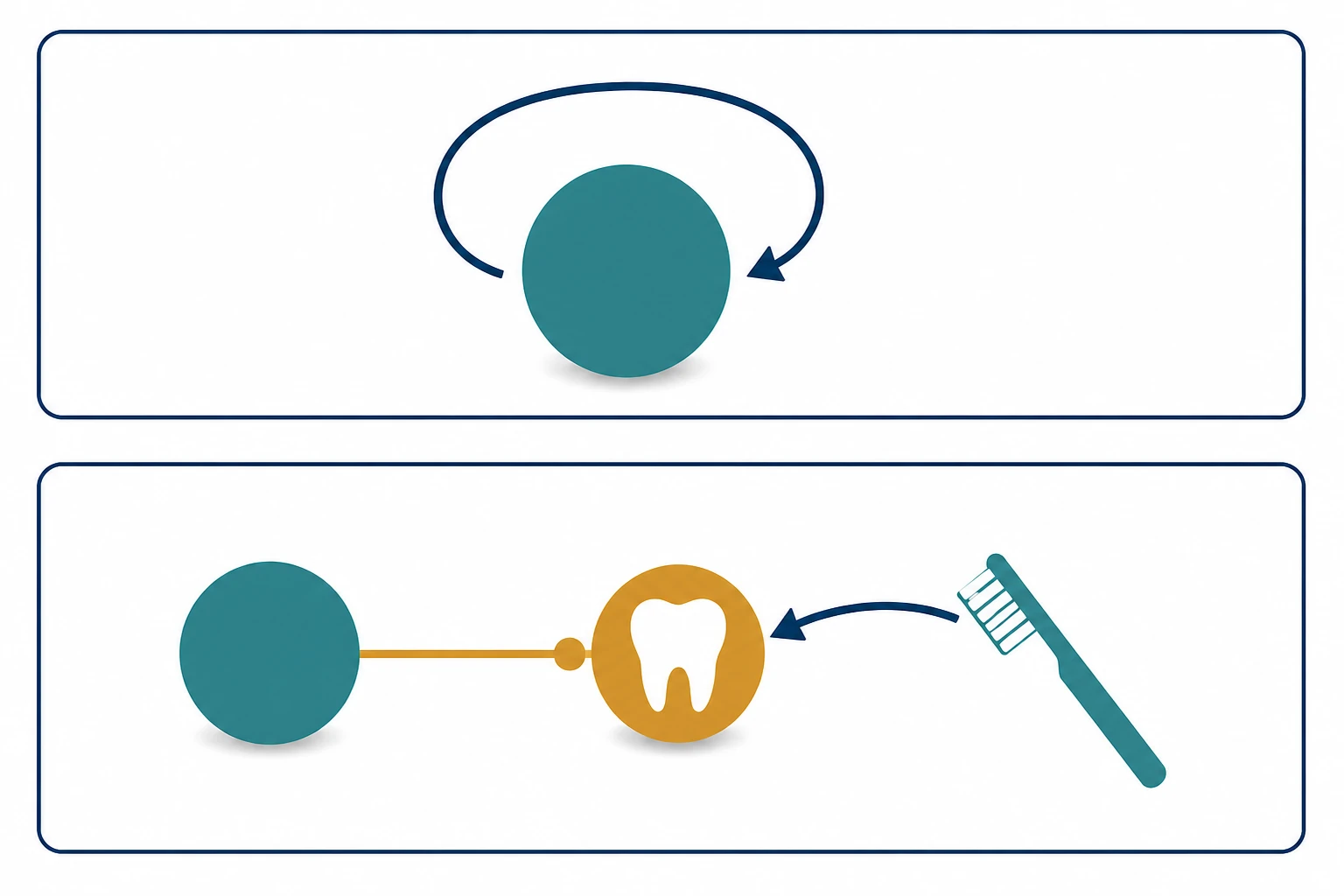
Without another accusative object, the reflexive pronoun is commonly accusative: «Ich wasche mich». If a body part appears as the direct object, the affected participant is expressed in the dative: «Ich wasche mir die Hände». This pattern does not replace each verb’s lexical government.
Many verbs are learnt with a fixed preposition: sich freuen auf for something expected, sich freuen über for a present or realised reason, sich interessieren für and sich erinnern an. The preposition and its case belong to the lexical entry.
In the Perfekt, reflexive constructions use haben: «Ich habe mich beeilt». The pronoun occupies the middle field; it is not sent to the end, but its exact position also depends on the subject, other pronouns and complements: «Heute habe ich mich beeilt».
Choose the pronoun by person, function and government, not by translation. This keeps lexical reflexivity, reciprocal readings and the body-part pattern separate instead of assigning one false class to every verb.
Reflexive pronouns: two cases
| Item | Form |
|---|---|
| 1 | ich · mich · mir |
| 2 | du · dich · dir |
| 3 | er · sich · sich |
| 4 | sie (singular) · sich · sich |
| 5 | es · sich · sich |
| 6 | wir · uns · uns |
| 7 | ihr · euch · euch |
| 8 | sie (plural) · sich · sich |
| 9 | Sie · sich · sich |
Choosing the case
| Item | Form |
|---|---|
| 1 | no other direct object · Ich wasche mich. |
| 2 | with a body part as direct object · Ich wasche mir die Hände. |
| 3 | lexically reflexive meaning · Wir erinnern uns. |
| 4 | reciprocal possible in the plural · Sie treffen sich. |
How it sounds
- Ich freue mich auf das Wochenende.The pronoun changes with the person and the preposition is fixed.
- Ich wasche mich jeden Morgen.With no other object, the pronoun is accusative.
- Ich wasche mir die Hände.With another direct object, the pronoun moves to the dative.
- Ich habe mich sehr beeilt.In the Perfekt, a reflexive construction uses haben and the pronoun stays in the middle field.
Check objective 1Another case
A proposed answer is “dich” for this case: “Ihr interessiert dich für moderne Kunst.”. Choose the only valid form.
A proposed answer is “mich” for this case: “Ihr interessiert mich für moderne Kunst.”. Choose the only valid form.
Answer available without interaction
Answer: euch — The subject ihr selects euch; sich interessieren requires the reflexive pronoun.
The subject ihr selects euch; sich interessieren requires the reflexive pronoun.
Answer: euch — The subject ihr selects euch; sich interessieren requires the reflexive pronoun.
The subject ihr selects euch; sich interessieren requires the reflexive pronoun.
Check objective 2Another case
A proposed answer is “mich” for this case: “Ich putze mich die Zähne.”. Choose the only valid form.
A proposed answer is “sich” for this case: “Ich putze sich die Zähne.”. Choose the only valid form.
Answer available without interaction
Answer: mir — die Zähne is already the direct object; the affected participant appears in the dative: mir.
die Zähne is already the direct object; the affected participant appears in the dative: mir.
Answer: mir — die Zähne is already the direct object; the affected participant appears in the dative: mir.
die Zähne is already the direct object; the affected participant appears in the dative: mir.
Check objective 3Another case
A proposed answer is “sie” for this case: “Bilde die reflexive Bedeutung sich erinnern: Frau Keller erinnert sie an den Termin.”. Choose the only valid form.
A proposed answer is “ihr” for this case: “Bilde die reflexive Bedeutung sich erinnern: Frau Keller erinnert ihr an den Termin.”. Choose the only valid form.
Answer available without interaction
Answer: sich — The subject is third-person singular and sich erinnern is lexically reflexive: sich.
The subject is third-person singular and sich erinnern is lexically reflexive: sich.
Answer: sich — The subject is third-person singular and sich erinnern is lexically reflexive: sich.
The subject is third-person singular and sich erinnern is lexically reflexive: sich.
When it doesn't hold
What breaks the rule, said out loud. Hiding it is what makes you feel cheated in the exam.
- sich vorstellen changes meaning with the case: accusative is to introduce yourself, dative is to imagine.Ich stelle mich vor. – Ich stelle mir das vor.
- With a plural, the pronoun can mean each other rather than themselves.Sie treffen sich jeden Freitag.
- With body parts German prefers the article and a dative pronoun, not the possessive.Ich putze mir die Zähne.
What your own language pushes you to say
Wrong Ich freue auf das Wochenende.
Right Ich freue mich auf das Wochenende.
English drops the reflexive pronoun with most of these verbs —I look forward— so the German pronoun simply never gets typed. Without it the verb is incomplete and the sentence stops being German.
Challenge: apply every rule
Solve every case and justify each choice: 1) A proposed answer is “dich” for this case: “Ihr interessiert dich für moderne Kunst.”. Choose the only valid form. 2) A proposed answer is “mich” for this case: “Ich putze mich die Zähne.”. Choose the only valid form. 3) A proposed answer is “sie” for this case: “Bilde die reflexive Bedeutung sich erinnern: Frau Keller erinnert sie an den Termin.”. Choose the only valid form.
Answer available without interaction
- Recognise the pattern taught in “Reflexive verbs: sich, and the mich that is sometimes mir” in a short example.
- Choose the appropriate form from “Reflexive verbs: sich, and the mich that is sometimes mir” using explicit evidence.
- Apply and justify the rule from “Reflexive verbs: sich, and the mich that is sometimes mir” in a new case.
Answer: euch · mir · sich
The subject ihr selects euch; sich interessieren requires the reflexive pronoun. die Zähne is already the direct object; the affected participant appears in the dative: mir. The subject is third-person singular and sich erinnern is lexically reflexive: sich.
Continue along this corridor
Practise this: Reflexive verbs: sich, and the mich that is sometimes mirRelative clauses: der, die, das all over again