

CEFR B1
What you will learn
- Build a real condition with si plus present indicative.
- Choose a present, future-oriented or imperative result that follows from the stated condition.
- Keep future forms and the conditional mood out of the real si-clause and distinguish conditional si from interrogative si meaning whether.
Before you start
- Have studied “The imperfect and pluperfect subjunctive: distance, sequence and unreal frames”.
- Have studied “Future choices and conditional wishes”.
The idea
A real conditional links a condition the speaker treats as possible with its consequence: “Si hay entradas, vamos al concierto.” It does not claim that tickets exist; it keeps that possibility open. At this level the si-clause uses the indicative. Hypothetical “si tuviera” and impossible-past “si hubiera tenido” patterns belong to the B2 inventory and are deliberately deferred.
Spanish presents the condition with a present form even when it refers to tomorrow: “Si mañana nieva, nos quedaremos en casa.” The future belongs to the consequence, not directly after conditional si.
The result need not be future. It can state a general effect, a current plan, permission, obligation or an instruction.
Complete B1 real-conditional pattern
| si-clause | result | function | model |
|---|---|---|---|
| si + present indicative | present indicative | regular result or general relation | Si descanso, trabajo mejor. |
| si + present indicative | ir a + infinitive | plan | Si acaba pronto, vamos a salir. |
| si + present indicative | future | prediction or consequence | Si queda sitio, entraremos. |
| si + present indicative | imperative | instruction | Si ves a Nora, llámame. |
| si + present indicative | modal + infinitive | possibility or obligation | Si tienes la clave, puedes entrar. |
How it sounds
- Si llega el paquete y la oficina está cerrada, déjalo en recepción.Arrival remains a possible future condition, so the si-clause uses present indicative. The result is an instruction, so it uses an imperative. The instruction only applies if the condition is met.
Check objective 1Another case
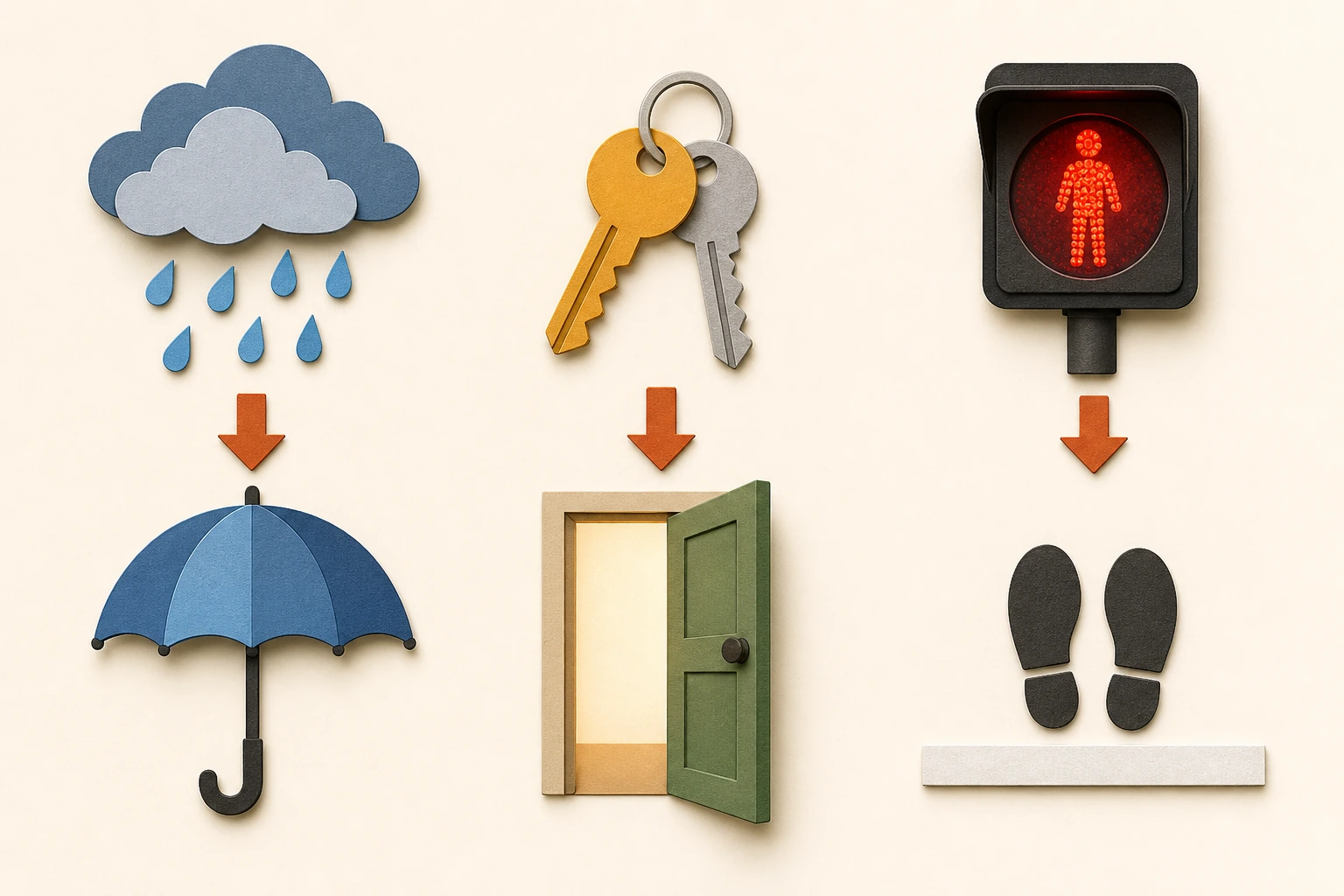
A proposed answer is “hará” for this case: “Use the rain and umbrella pair. Si mañana hará mal tiempo, llevaremos paraguas. (hacer)”. Choose the only valid form.
A proposed answer is “haga” for this case: “Use the rain and umbrella pair. Si mañana haga mal tiempo, llevaremos paraguas. (hacer)”. Choose the only valid form.
Answer available without interaction
Answer: hace — This is an open future condition, so the si-clause uses present indicative: hace. The future form remains in the result.
This is an open future condition, so the si-clause uses present indicative: hace. The future form remains in the result.
Answer: hace — This is an open future condition, so the si-clause uses present indicative: hace. The future form remains in the result.
This is an open future condition, so the si-clause uses present indicative: hace. The future form remains in the result.
Check objective 2Another case
Give an affirmative tú instruction after the condition: Si encuentras las dos llaves, ___ la puerta. (abrir)
Give an affirmative tú instruction after the condition: Si encuentras las dos llaves, ___ la puerta. (abrir)
Answer available without interaction
Answer: abre — The condition uses present indicative encuentras. The result is an affirmative tú instruction, so abrir becomes abre.
The condition uses present indicative encuentras. The result is an affirmative tú instruction, so abrir becomes abre.
Answer: abre — The condition uses present indicative encuentras. The result is an affirmative tú instruction, so abrir becomes abre.
The condition uses present indicative encuentras. The result is an affirmative tú instruction, so abrir becomes abre.
Check objective 3Another case
Choose the only valid real condition for a possible event tomorrow.
Choose the sentence where si means whether rather than introducing a condition.
Answer available without interaction
Answer: Si mañana llueve, no salimos. — A real conditional si-clause uses present indicative, not future or conditional.
A real conditional si-clause uses present indicative, not future or conditional.
Answer: No sé si habrá plazas. — After no sé, si introduces an embedded question meaning whether, so future is possible.
After no sé, si introduces an embedded question meaning whether, so future is possible.
What your own language pushes you to say
Wrong Si mañana lloverá, no salimos.
Right Si mañana llueve, no salimos.
Tomorrow does not force a future form inside the condition. Present indicative marks the open condition.
Challenge: apply every rule
Solve every case and justify each choice: 1) A proposed answer is “abre” for this case: “Use the rain and umbrella pair. Si mañana abre mal tiempo, llevaremos paraguas. (hacer)”. Choose the only valid form. 2) A proposed answer is “hace” for this case: “Use the two keys and the door. Si encuentras las dos llaves, hace la puerta. (abrir, tú)”. Choose the only valid form. 3) Choose the only valid real condition for a possible event tomorrow.
Answer available without interaction
- Build a real condition with si plus present indicative.
- Choose a present, future-oriented or imperative result that follows from the stated condition.
- Keep future forms and the conditional mood out of the real si-clause and distinguish conditional si from interrogative si meaning whether.
Answer: hace · abre · Si mañana llueve, no salimos.
This is an open future condition, so the si-clause uses present indicative: hace. The future form remains in the result. The condition uses present indicative encuentras. The result is an affirmative tú instruction, so abrir becomes abre. A real conditional si-clause uses present indicative, not future or conditional.
Curriculum alignment and sources
- B1 learners handle likely familiar situations, explain plans and give brief reasons; real conditions organise those connected statements. · CEFR descriptors search
- The B1 column lists present indicative in the protasis, incompatibility with future there, present/future or imperative results, and real conditions. Imperfect/pluperfect subjunctive hypotheses are listed in B2 and are excluded. · ic-pcic-grammar-b1-b2