

CEFR A1
What you will learn
- Choose a definite or indefinite article that matches a noun in gender and number.
- Form the regular plural of common A1 nouns and adjectives.
- Make article, noun and adjective agree across a complete noun phrase.
Before you start
- Recognise the vocabulary and forms shown in this lesson’s key idea and paradigm.
The idea
Spanish nouns belong to a grammatical gender: masculine or feminine. Gender is part of the word's grammar, not a judgement about the object. A table can be feminine and a book masculine even though neither object has a biological sex. The safest learning unit is therefore not “mesa” but “la mesa”, and not “libro” but “el libro”. The article carries information that an English noun does not show.
Many nouns ending in -o are masculine and many ending in -a are feminine. Common nouns ending in -ción, -sión or -dad are usually feminine. These patterns help, but they do not replace the article: “el problema”, “el día” and “la mano” show why guessing from the last letter can fail.
Names of people ending in -ista normally keep the same noun form while the article changes: “el artista” and “la artista”. A1 learners do not need to memorise every exception at once; they do need to store each new noun with an article.
The complete A1 article set
| gender and number | definite: the | indefinite: a, an, some |
|---|---|---|
| masculine singular | el | un |
| feminine singular | la | una |
| masculine plural | los | unos |
| feminine plural | las | unas |
Regular number and adjective agreement
| base | singular phrase | plural phrase | change |
|---|---|---|---|
| vowel ending | la ventana clara | las ventanas claras | +s on noun and adjective |
| consonant ending | el papel gris | los papeles grises | +es on noun and adjective |
| adjective in -e | el coche grande / la casa grande | los coches grandes / las casas grandes | same gender form; number still changes |
How it sounds
- unas ventanas pequeñas“Ventana” is feminine, so its plural article must also be feminine. The noun ends in a vowel, so add -s: “ventanas”. The adjective copies feminine plural: “pequeñas”.
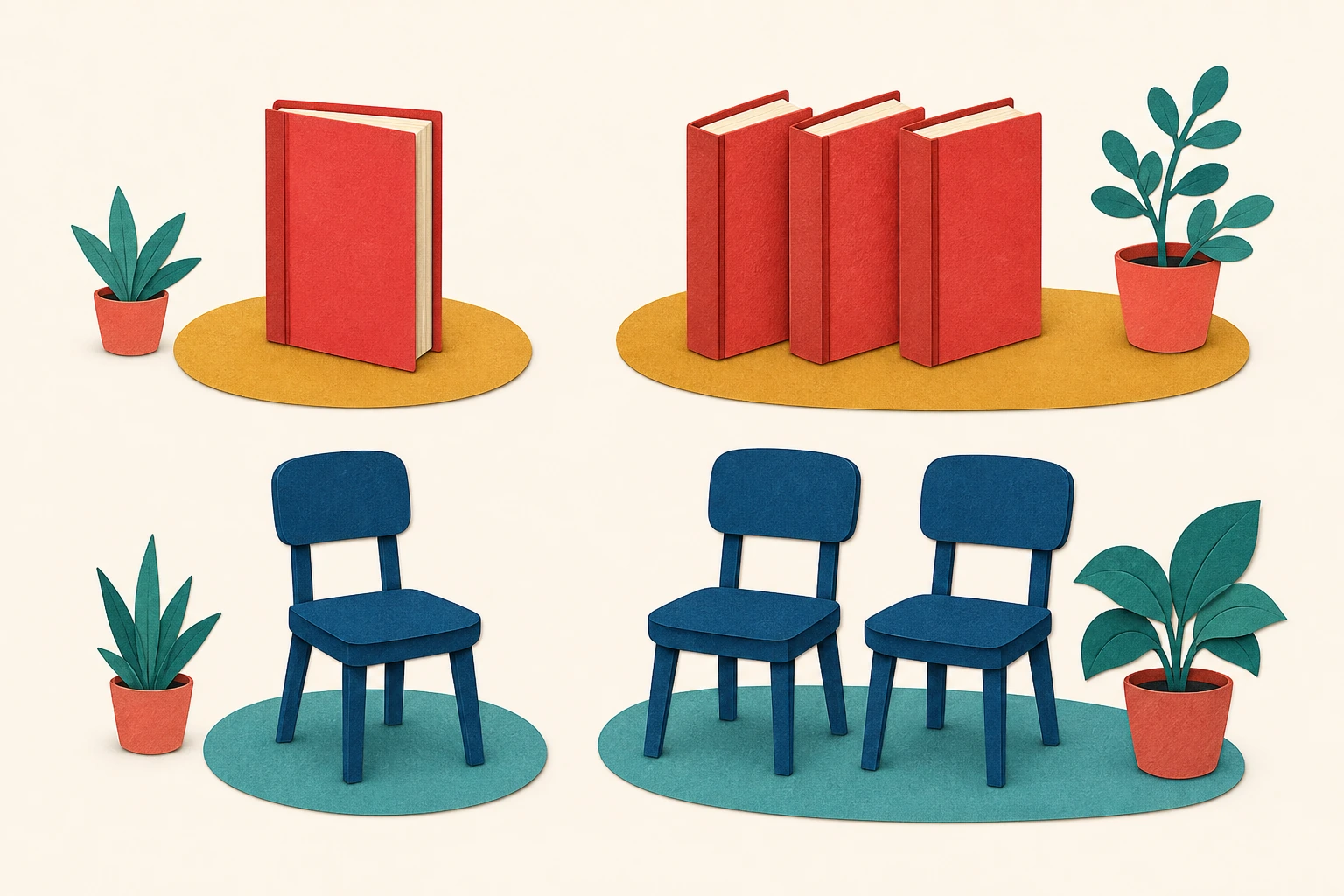
Check objective 1Another case
A proposed answer is “el silla azul” for this case: “Describe the single blue chair with a definite article, the noun “silla” and the adjective “azul”.”. Choose the only valid form.
A proposed answer is “unas sillas azules” for this case: “Describe the single blue chair with a definite article, the noun “silla” and the adjective “azul”.”. Choose the only valid form.
Answer available without interaction
Answer: la silla azul — Silla is feminine singular; “azul” has the same singular form for both genders.
“Silla” is feminine singular; “azul” has the same singular form for both genders.
Answer: la silla azul — Silla is feminine singular; “azul” has the same singular form for both genders.
“Silla” is feminine singular; “azul” has the same singular form for both genders.
Check objective 2Another case
A proposed answer is “unos sillas azules” for this case: “Change “una silla azul” so it describes the two blue chairs in the lower-right group.”. Choose the only valid form.
A proposed answer is “la silla azul” for this case: “Change “una silla azul” so it describes the two blue chairs in the lower-right group.”. Choose the only valid form.
Answer available without interaction
Answer: unas sillas azules — The noun adds -s, the adjective ending in a consonant adds -es, and the article becomes feminine plural.
The noun adds -s, the adjective ending in a consonant adds -es, and the article becomes feminine plural.
Answer: unas sillas azules — The noun adds -s, the adjective ending in a consonant adds -es, and the article becomes feminine plural.
The noun adds -s, the adjective ending in a consonant adds -es, and the article becomes feminine plural.
Check objective 3Another case
A proposed answer is “las libros rojas” for this case: “The upper-right group shows three matching red books. Which complete phrase describes it?”. Choose the only valid form.
A proposed answer is “el libro rojo” for this case: “The upper-right group shows three matching red books. Which complete phrase describes it?”. Choose the only valid form.
Answer available without interaction
Answer: los libros rojos — Libro is masculine and the picture shows more than one, so article, noun and adjective all take masculine plural form.
“Libro” is masculine and the picture shows more than one, so article, noun and adjective all take masculine plural form.
Answer: los libros rojos — Libro is masculine and the picture shows more than one, so article, noun and adjective all take masculine plural form.
“Libro” is masculine and the picture shows more than one, so article, noun and adjective all take masculine plural form.
What your own language pushes you to say
Wrong los casas blanco
Right las casas blancas
In Spanish the article and the adjective must both match the feminine plural noun.
Challenge: apply every rule
Solve every case and justify each choice: 1) A proposed answer is “los libros rojos” for this case: “Describe the single blue chair with a definite article, the noun “silla” and the adjective “azul”.”. Choose the only valid form. 2) A proposed answer is “los libros rojos” for this case: “Change “una silla azul” so it describes the two blue chairs in the lower-right group.”. Choose the only valid form. 3) A proposed answer is “las libros rojas” for this case: “The upper-right group shows three matching red books. Which complete phrase describes it?”. Choose the only valid form.
Answer available without interaction
- Choose a definite or indefinite article that matches a noun in gender and number.
- Form the regular plural of common A1 nouns and adjectives.
- Make article, noun and adjective agree across a complete noun phrase.
Answer: la silla azul · unas sillas azules · los libros rojos
“Silla” is feminine singular; “azul” has the same singular form for both genders. The noun adds -s, the adjective ending in a consonant adds -es, and the article becomes feminine plural. “Libro” is masculine and the picture shows more than one, so article, noun and adjective all take masculine plural form.
Curriculum alignment and sources
- A1 general linguistic range: basic expressions and some basic one-clause structures; the selection of gender and agreement as enabling grammar is editorial. · CEFR descriptors search
- A1 inventory: common noun gender, regular noun number, adjective gender and number, postnominal qualifying adjectives, and the regular definite-article paradigm el/la/los/las. · Plan Curricular del Instituto Cervantes: Gramática, inventario A1-A2
Continue along this corridor
Practise this: Every noun is “el” or “la”Practise this: Adjectives agree, and they come afterPractise this: “El café”, “los lunes”, “el español”The present tense: three endings to start speakingOne English “to be”, three Spanish choices