

CEFR B2
What you will learn
- Separate obligation from inference in modal periphrases.
- Choose a phase periphrasis for beginning, repetition, interruption or recent completion.
- Use gerund periphrases to express continuity, accumulated duration and gradual development.
Before you start
- Have studied “The present tense: three endings to start speaking”.
The idea
In a verbal periphrasis, the two verb forms behave as one predicate. The first verb carries person, number, tense and mood; the infinitive, gerund or participle names the event and helps express obligation, phase, duration or result. Not every adjacent pair of verbs is a periphrasis. In “Salió corriendo”, the gerund can describe manner; in “Sigue corriendo”, seguir presents the event as continuing. Meaning and syntactic unity matter.
With an infinitive or gerund periphrasis, an unstressed object pronoun normally has two controlled positions: “Lo voy a revisar / Voy a revisarlo” and “Lo sigue buscando / Sigue buscándolo”. The meaning stays stable, but written accents may be required after attachment.
Do not split the preposition away from the infinitive: “vuelve a intentarlo”, not “vuelve intentarlo”.
Infinitive periphrases locate a phase
| phase | pattern | what it profiles |
|---|---|---|
| immediate beginning | ponerse a + infinitive | sudden or contextually marked start |
| beginning | empezar / comenzar a + infinitive | entry into an event |
| repetition | volver a + infinitive | event occurs again |
| interruption | dejar de + infinitive | event ceases |
| recent completion | acabar de + infinitive | event has just occurred |
| eventual achievement | llegar a + infinitive | endpoint reached after a process |
Gerund periphrases shape an event in progress
| pattern | value | required information |
|---|---|---|
| seguir / continuar + gerund | continuation | an event already under way |
| llevar + duration + gerund | accumulated duration up to the reference point | an explicit or recoverable span |
| ir + gerund | gradual cumulative development | a change unfolding by stages |
| andar + gerund | distributed or recurrent activity, often evaluative | a context that supports the speaker's stance |
Complete present and imperfect paradigms: llevar + duration + gerund
| person | present with dos años | imperfect with dos años |
|---|---|---|
| yo | llevo dos años trabajando | llevaba dos años trabajando |
| tú | llevas dos años trabajando | llevabas dos años trabajando |
| él / ella / usted | lleva dos años trabajando | llevaba dos años trabajando |
| nosotros / nosotras | llevamos dos años trabajando | llevábamos dos años trabajando |
| vosotros / vosotras | lleváis dos años trabajando | llevabais dos años trabajando |
| ellos / ellas / ustedes | llevan dos años trabajando | llevaban dos años trabajando |
How it sounds
- Se puso a ordenar el archivo.
- Seguimos buscando una alternativa.
- Deben de haber salido.
Check objective 1Another case
Choose the interpretation of Debe de estar en casa.
Choose the interpretation of Debes entregar el informe hoy.
Answer available without interaction
Answer: inference — Deber de plus infinitive expresses a reasoned inference in this contrast.
Deber de plus infinitive expresses a reasoned inference in this contrast.
Answer: obligation — Deber plus infinitive expresses obligation in this context.
Deber plus infinitive expresses obligation in this context.
Check objective 2Another case
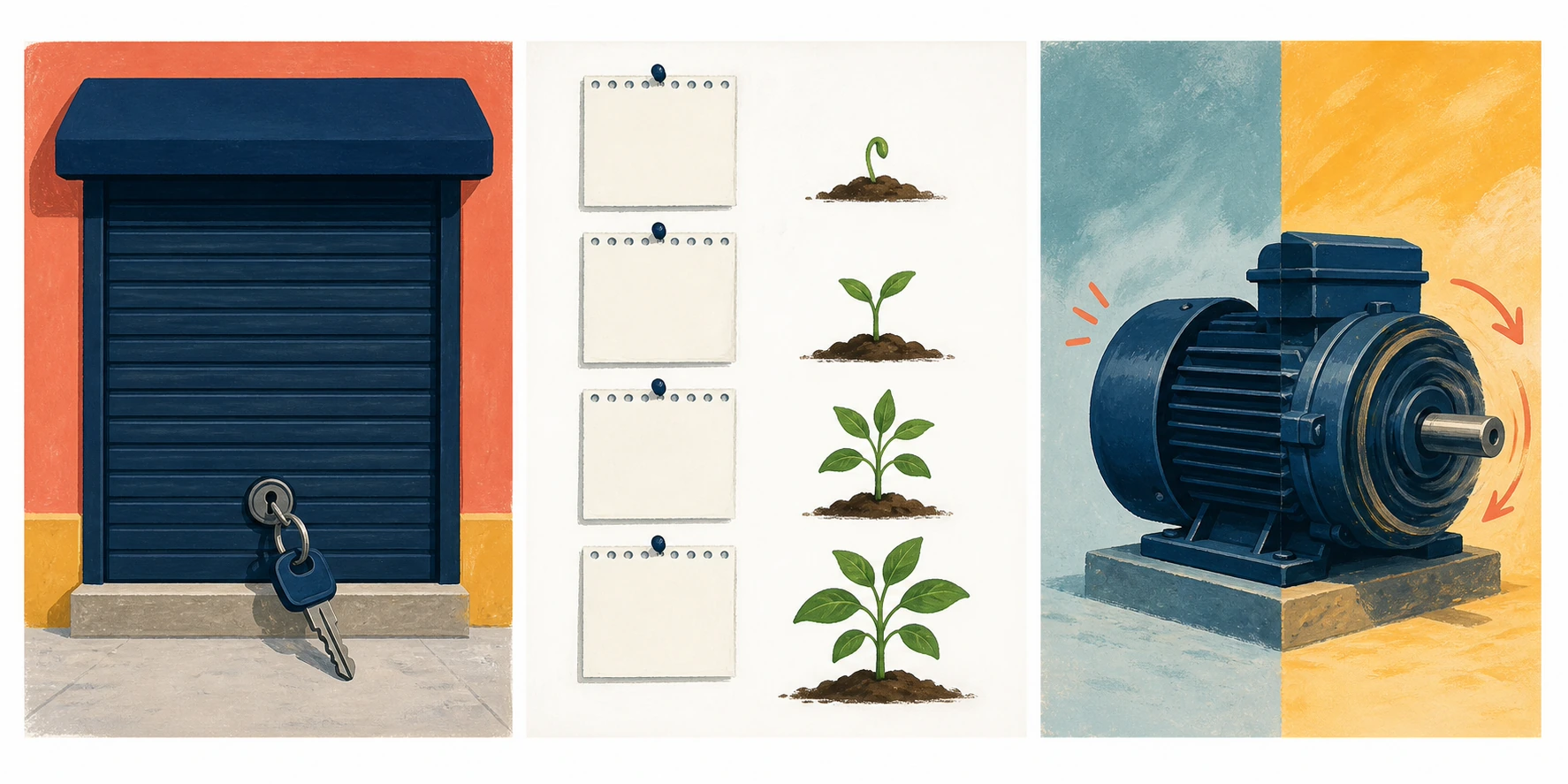
Use the present of acabar in the recent-completion construction: Ahora mismo Lucía ___ de cerrar la tienda. (acabar)
Use the present of acabar in the recent-completion construction: Ahora mismo Lucía ___ de cerrar la tienda. (acabar)
Answer available without interaction
Answer: acaba — The visual establishes immediate recent completion, so acabar de plus infinitive is selected. Lucía takes third-person singular present: acaba.
The visual establishes immediate recent completion, so acabar de plus infinitive is selected. Lucía takes third-person singular present: acaba.
Answer: acaba — The visual establishes immediate recent completion, so acabar de plus infinitive is selected. Lucía takes third-person singular present: acaba.
The visual establishes immediate recent completion, so acabar de plus infinitive is selected. Lucía takes third-person singular present: acaba.
Check objective 3Another case
Use the simple future of llevar in the duration construction: Para el próximo agosto, la planta ___ cuatro meses creciendo junto a la ventana. (llevar)
Use the simple future of llevar in the duration construction: Para el próximo agosto, la planta ___ cuatro meses creciendo junto a la ventana. (llevar)
Answer available without interaction
Answer: llevará — The clause projects an accumulated duration to a future reference point. The singular subject planta selects future llevará plus the duration and gerund.
The clause projects an accumulated duration to a future reference point. The singular subject planta selects future llevará plus the duration and gerund.
Answer: llevará — The clause projects an accumulated duration to a future reference point. The singular subject planta selects future llevará plus the duration and gerund.
The clause projects an accumulated duration to a future reference point. The singular subject planta selects future llevará plus the duration and gerund.
What your own language pushes you to say
Wrong You must submit it today → Debes de entregarlo hoy.
Right You must submit it today → Debes entregarlo hoy.
For the explicit B2 contrast taught here, deber plus infinitive expresses obligation; deber de plus infinitive expresses an inference such as “Debe de estar cerrado”. Usage varies, so the distinction is a production control, not a claim that every speaker always maintains it.
Challenge: apply every rule
Solve every case and justify each choice: 1) Choose the interpretation of Debe de estar en casa. 2) A proposed answer is “llevará” for this case: “Use the freshly closed shutter and key. Ahora mismo, Lucía llevará de cerrar la tienda; aún tiene la llave fuera. (acabar)”. Choose the only valid form. 3) A proposed answer is “acaba” for this case: “Use four calendar pages and the continuing growth. Para el próximo agosto, la planta acaba cuatro meses creciendo junto a la ventana. (llevar)”. Choose the only valid form.
Answer available without interaction
- Separate obligation from inference in modal periphrases.
- Choose a phase periphrasis for beginning, repetition, interruption or recent completion.
- Use gerund periphrases to express continuity, accumulated duration and gradual development.
Answer: inference · acaba · llevará
Deber de plus infinitive expresses a reasoned inference in this contrast. The visual establishes immediate recent completion, so acabar de plus infinitive is selected. Lucía takes third-person singular present: acaba. The clause projects an accumulated duration to a future reference point. The singular subject planta selects future llevará plus the duration and gerund.
Curriculum alignment and sources
- B2 learners can convey finer temporal and modal relationships in connected explanations; the taxonomy is editorial. · CEFR descriptors search
- The inventory distributes periphrastic identification and several phase forms across B1, and adds B2 values including deber de and ponerse a. The unit consolidates these prerequisite and B2 contrasts without presenting a closed official list. · ic-pcic-grammar-b1-b2