

CEFR C1
What you will learn
- Recognise a collocation as a conventional lexical combination and learn it as a unit.
- Distinguish a lexical collocation from a function-verb construction and explain its register or phase value.
Before you start
- Have studied “Verb-second: slots, not words”.
- Have studied “N-declension: der Student, den Studenten”.
- Have studied “Subjective modals: deduction, possibility and source”.
The idea
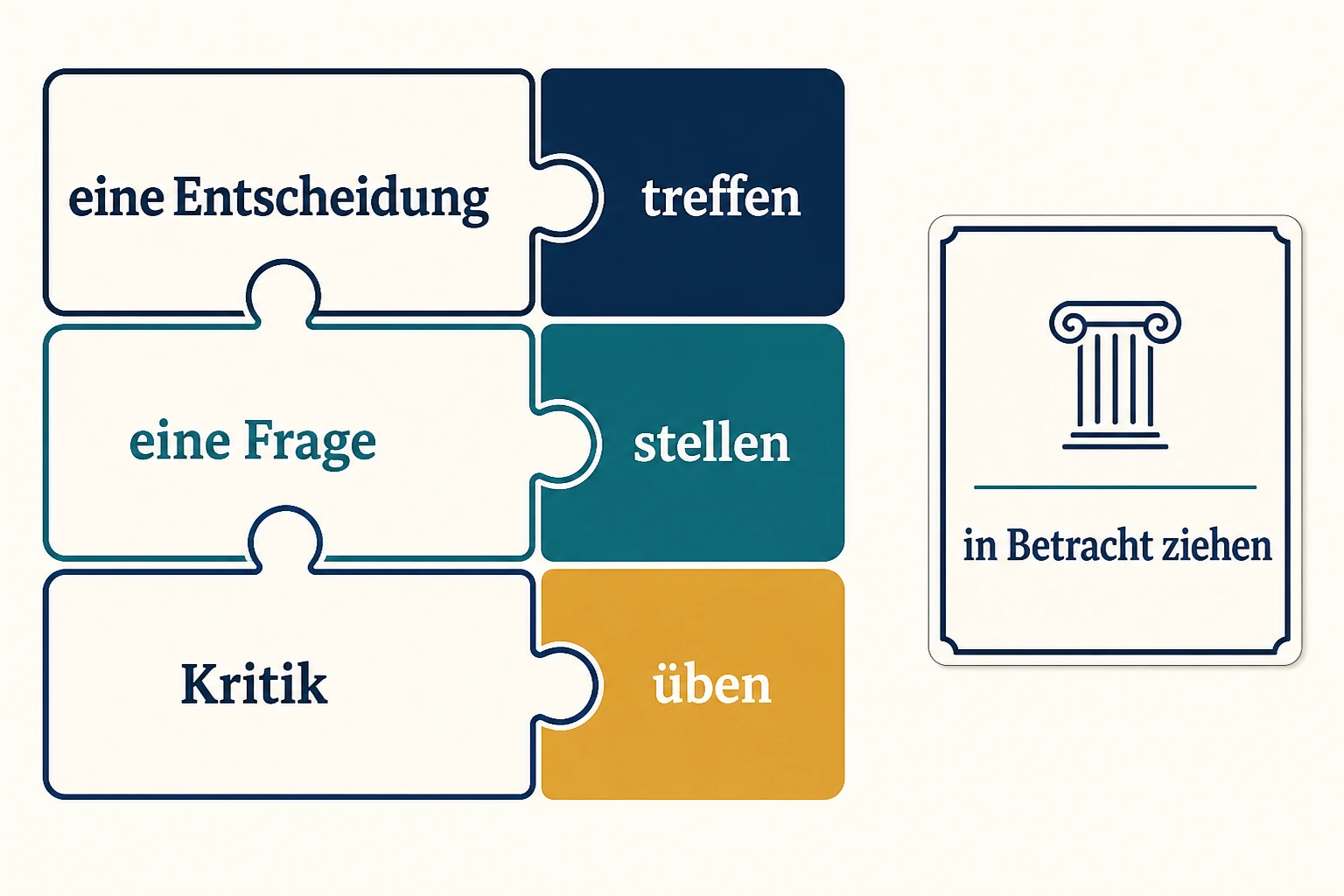
A collocation is a combination that a speech community selects conventionally. A sentence may be understandable and grammatical yet fail to be the usual choice: German uses eine Entscheidung treffen, eine Frage stellen and Kritik üben. C1 control means managing such associations and selecting them for context, not collecting isolated verbs.
Collocation is the broad term. It includes conventional pairings such as ein Versprechen halten, Maßnahmen ergreifen, eine Rolle spielen and Verantwortung übernehmen. The verb retains part of its meaning, but free substitution changes naturalness or sense. Record the article, case, preposition and verb form together with the noun.
A Funktionsverbgefüge is a more specific construction. A semantically weakened verb combines with an abstract noun or prepositional group carrying the lexical core: zur Verfügung stellen, zur Kenntnis nehmen, in Bewegung geraten. The verb can still signal state, onset or causation; it is not simply empty. Some constructions have a nearby simple verb, but the equivalence is not always complete.
These constructions are especially frequent in specialist and administrative texts, but a longer phrase is not automatically better German. Register, precision and process phase decide. etwas prüfen names the action; etwas zur Prüfung vorlegen presents the step of submitting something for examination. Compare function and context instead of mechanically nominalising every verb.
Combinations learned as units
| Noun | Selected verb | Example |
|---|---|---|
| eine Entscheidung | treffen | eine schwierige Entscheidung treffen |
| eine Frage | stellen | eine präzise Frage stellen |
| ein Versprechen | halten | ein gegebenes Versprechen halten |
| Kritik | üben | sachliche Kritik üben |
| Maßnahmen | ergreifen | wirksame Maßnahmen ergreifen |
| Verantwortung | übernehmen | persönliche Verantwortung übernehmen |
The construction can mark a phase
| Phase | Pattern | Reading |
|---|---|---|
| Zustand | in Bewegung sein | sich bereits bewegen |
| Beginn | in Bewegung geraten/kommen | anfangen, sich zu bewegen |
| Verursachung | etwas in Bewegung bringen/setzen | bewirken, dass es sich bewegt |
| Bereitstellung | etwas zur Verfügung stellen | etwas verfügbar machen |
| Rezeption | etwas zur Kenntnis nehmen | etwas bewusst registrieren |
How it sounds
- Die neuen Regeln treten am 1. Januar in Kraft.The core in Kraft refers to a rule being in force. The sentence describes the onset of that state. The onset construction is in Kraft treten, and the verb inflects like treten.
Check objective 1Another case
A proposed answer is “greifen” for this case: “Choose the conventional pairing: Die Leitung muss sofort Maßnahmen greifen.”. Choose the only valid form.
A proposed answer is “nehmen” for this case: “Choose the conventional pairing: Die Leitung muss sofort Maßnahmen nehmen.”. Choose the only valid form.
Answer available without interaction
Answer: ergreifen — The collocation is Maßnahmen ergreifen. The modal muss places the infinitive ergreifen at the end.
The collocation is Maßnahmen ergreifen. The modal muss places the infinitive ergreifen at the end.
Answer: ergreifen — The collocation is Maßnahmen ergreifen. The modal muss places the infinitive ergreifen at the end.
The collocation is Maßnahmen ergreifen. The modal muss places the infinitive ergreifen at the end.
Check objective 2Another case
A proposed answer is “Die Maschine ist in Bewegung.” for this case: “A report needs to mark that a machine begins to move. Which formulation encodes that phase?”. Choose the only valid form.
A proposed answer is “Die Maschine bringt die Anlage in Bewegung.” for this case: “A report needs to mark that a machine begins to move. Which formulation encodes that phase?”. Choose the only valid form.
Answer available without interaction
Answer: Die Maschine gerät in Bewegung. — The verb geraten marks entry into the state; sein expresses state and bringen causation.
geraten marks entry into the state; sein expresses state and bringen causation.
Answer: Die Maschine gerät in Bewegung. — The verb geraten marks entry into the state; sein expresses state and bringen causation.
geraten marks entry into the state; sein expresses state and bringen causation.
What your own language pushes you to say
Wrong Wir nehmen heute eine Entscheidung.
Right Wir treffen heute eine Entscheidung.
The structure is grammatical, but nehmen is a calque from other languages. German selects treffen with Entscheidung.
Challenge: apply every rule
Solve every case and justify each choice: 1) A proposed answer is “greifen” for this case: “Choose the conventional pairing: Die Leitung muss sofort Maßnahmen greifen.”. Choose the only valid form. 2) A proposed answer is “Die Maschine ist in Bewegung.” for this case: “A report needs to mark that a machine begins to move. Which formulation encodes that phase?”. Choose the only valid form.
Answer available without interaction
- Recognise a collocation as a conventional lexical combination and learn it as a unit.
- Distinguish a lexical collocation from a function-verb construction and explain its register or phase value.
Answer: ergreifen · Die Maschine gerät in Bewegung.
The collocation is Maßnahmen ergreifen. The modal muss places the infinitive ergreifen at the end. geraten marks entry into the state; sein expresses state and bringen causation.
Curriculum alignment and sources
- CEFR C1: broad lexical repertoire, precision and flexible reformulation; the collocation selection is editorial. · Common European Framework of Reference for Languages: Companion Volume
- Definition, structure, diagnostics and frequent use of Funktionsverbgefüge in specialist and administrative language. · ids-funktionsverbgefuege
Continue along this corridor
Practise this: Words that look like yours and are not, and the ones that travel in pairsPractise this: eine Entscheidung treffen: the verb that lives inside the nounSubjective modals: deduction, possibility and sourceWritten, spoken and register-appropriate German