

CEFR C1
What you will learn
- Analyse medium, situation, audience, purpose and genre to describe register without reducing it to a spoken/written binary.
- Reformulate a message for a specific context and justify changes in syntax, tense, nominal density and explicitness.
Before you start
- Have studied “Verb-second: slots, not words”.
- Have studied “Concession and clause chaining”.
- Have studied “Collocations and function-verb constructions”.
The idea
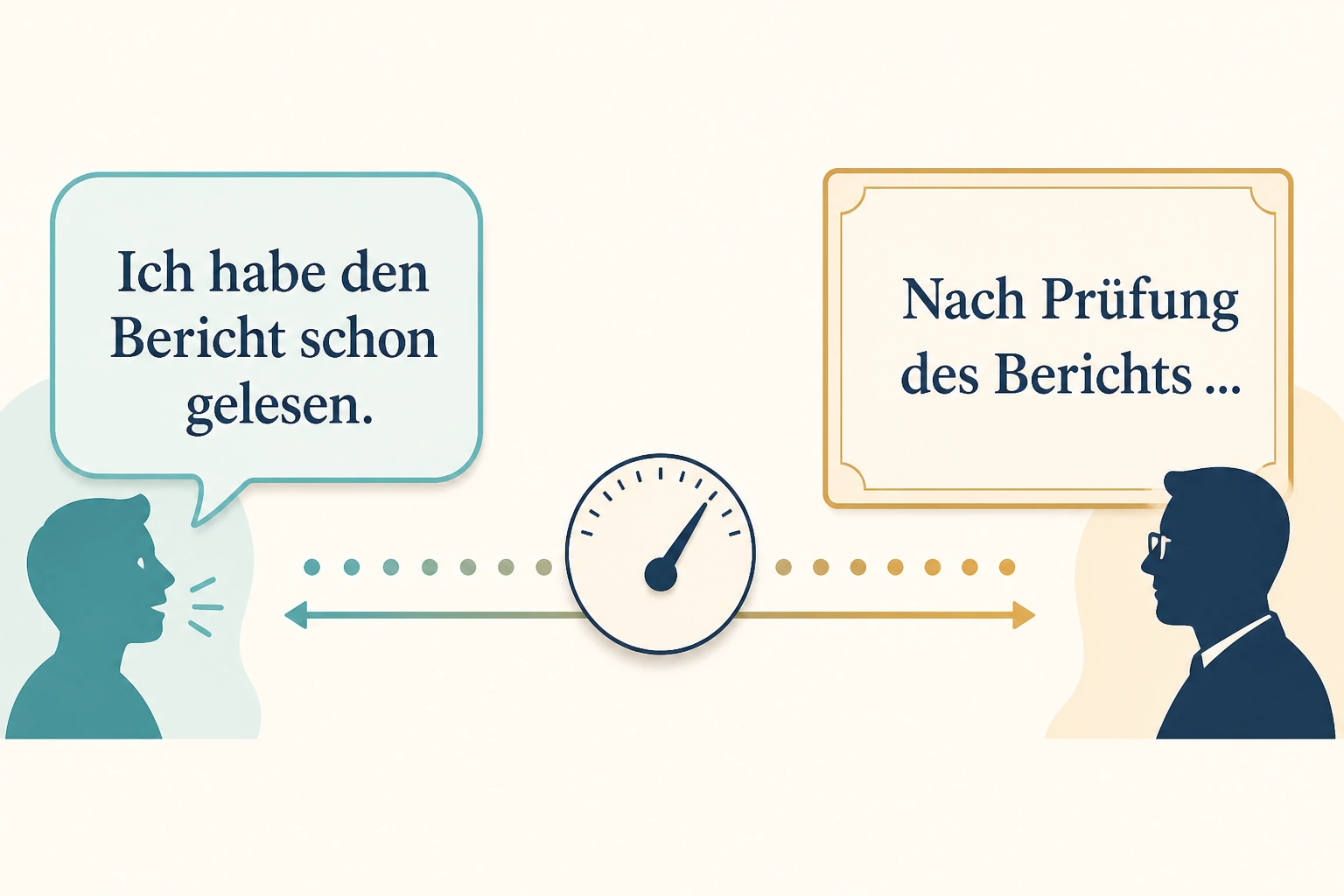
There is no automatic translation between 'informal speech' and 'formal writing'. A read-aloud speech is delivered by voice but may be carefully planned; a chat is written but may reproduce conversational proximity, ellipsis and self-repair. At C1, choices follow audience, relationship, purpose, genre, medium and degree of planning.
Medium distinguishes phonic from graphic delivery. Conception distinguishes close, spontaneous, interactive communication from distant, planned and elaborated communication. Formality describes the social relationship and genre expectations. Information density describes how much is packaged into noun phrases, subordinate clauses or terminology. No single dimension determines the others.
Spontaneous conversation allows short turns, modal particles, context-bound references, ellipsis and self-repair. Planned prose tends to make relations explicit, maintain stable references and distribute information so the reader can recover it without asking. This does not license filling a report with nominalisations: a verbal formulation may be clearer and more accountable because it reveals who acts.
Nominalstil compresses processes into nouns and is frequent in technical and administrative domains: Nach Prüfung des Antrags erfolgt die Mitteilung. It can suit a context where procedure rather than agent is in focus. If it hides responsibility or stacks genitives, restore the verb: Nachdem die Sachbearbeiterin den Antrag geprüft hat, informiert sie die Beteiligten.
Perfekt is very frequent for past events in conversation, while Präteritum carries much written narrative. Distribution nevertheless varies by region, genre and verb. sein, haben and modal verbs frequently occur in Präteritum in speech too: Ich war müde; ich musste gehen. A report, news story and novel do not select tense in the same way either. The useful question is which form that genre expects for that verb, not whether the channel is voice or paper.
Dimensions of register
| Dimension | Pole A | Pole B | Counter-case to a binary rule |
|---|---|---|---|
| Medium | phonisch | graphisch | vorgelesene Rede / informeller Chat |
| Konzeption | Nähe, spontan | Distanz, geplant | geplantes Gespräch / spontane Nachricht |
| Formalität | informell | formell | höfliches Gespräch / interne Notiz |
| Informationsdichte | explizite Verben | kompakte Nominalgruppen | klarer Fachtext mit Verbalstil |
Tense also depends on verb and genre
| Context | Tendency | Example | Limit |
|---|---|---|---|
| Alltagsgespräch | Perfekt häufig | Ich habe den Bericht gelesen. | Region und Verb beeinflussen die Wahl. |
| Gespräch: sein/modal | Präteritum häufig | Ich war müde. Ich musste gehen. | Nicht jedes Verb folgt demselben Muster. |
| schriftliche Erzählung | Präteritum häufig | Sie öffnete die Tür. | Genre und Perspektive bleiben entscheidend. |
| Bericht/Protokoll | genreabhängige Mischung | Die Prüfung ergab ... / Es wurde festgestellt ... | Medium allein entscheidet nicht. |
How it sounds
- Der Bericht wurde bereits geprüft; zwei Zahlen stehen jedoch noch aus.The stable content is: review completed and two figures still missing. In formal minutes, the interactive marker Also is removed and the concessive relation made explicit. The missing information is not hidden and review is not turned into approval.
Check objective 1Another case
A proposed answer is “Nach erfolgter Lektüre des Berichts besteht das Fehlen zweier Anlagen.” for this case: “Someone gives a colleague a spontaneous update by phone. Which option fits best without turning the tendency into a universal rule?”. Choose the only valid form.
A proposed answer is “Der Bericht ward gelesen; zwei Anlagen ermangelten.” for this case: “Someone gives a colleague a spontaneous update by phone. Which option fits best without turning the tendency into a universal rule?”. Choose the only valid form.
Answer available without interaction
Answer: Ich habe den Bericht schon gelesen, aber mir fehlen noch zwei Anhänge. — The wording “Ich habe den Bericht schon gelesen, aber mir fehlen noch zwei Anhänge.” is clear, close and appropriate for a spontaneous update. It is not chosen merely because of Perfekt: it also retains agency, the missing information and accessible syntax.
The wording “Ich habe den Bericht schon gelesen, aber mir fehlen noch zwei Anhänge.” is clear, close and appropriate for a spontaneous update. It is not chosen merely because of Perfekt: it also retains agency, the missing information and accessible syntax.
Answer: Ich habe den Bericht schon gelesen, aber mir fehlen noch zwei Anhänge. — The wording “Ich habe den Bericht schon gelesen, aber mir fehlen noch zwei Anhänge.” is clear, close and appropriate for a spontaneous update. It is not chosen merely because of Perfekt: it also retains agency, the missing information and accessible syntax.
The wording “Ich habe den Bericht schon gelesen, aber mir fehlen noch zwei Anhänge.” is clear, close and appropriate for a spontaneous update. It is not chosen merely because of Perfekt: it also retains agency, the missing information and accessible syntax.
Check objective 2Another case
A proposed answer is “Prüfung des Antrags und des Ergebnisses” for this case: “For a short procedural heading, condense without changing content: Nachdem wir den Antrag geprüft haben, teilen wir das Ergebnis mit.”. Choose the only valid form.
A proposed answer is “Mitteilung des Antrags nach Prüfung des Ergebnisses” for this case: “For a short procedural heading, condense without changing content: Nachdem wir den Antrag geprüft haben, teilen wir das Ergebnis mit.”. Choose the only valid form.
Answer available without interaction
Answer: Mitteilung des Ergebnisses nach Prüfung des Antrags — The nominalisation works in a heading because the genre licenses omission of the agent. In the procedural body, the responsible party should be named where that information matters.
The nominalisation works in a heading because the genre licenses omission of the agent. In the procedural body, the responsible party should be named where that information matters.
Answer: Mitteilung des Ergebnisses nach Prüfung des Antrags — The nominalisation works in a heading because the genre licenses omission of the agent. In the procedural body, the responsible party should be named where that information matters.
The nominalisation works in a heading because the genre licenses omission of the agent. In the procedural body, the responsible party should be named where that information matters.
What your own language pushes you to say
Wrong Die Durchführung der Überprüfung der Einhaltung der Regelung erfolgt durch die Leitung.
Right Die Leitung prüft, ob die Beteiligten die Regelung einhalten.
Nominal stacking hides the action and chains genitives. The verbal version remains professional while making agent, process and content visible.
Challenge: apply every rule
Solve every case and justify each choice: 1) A proposed answer is “Nach erfolgter Lektüre des Berichts besteht das Fehlen zweier Anlagen.” for this case: “Someone gives a colleague a spontaneous update by phone. Which option fits best without turning the tendency into a universal rule?”. Choose the only valid form. 2) A proposed answer is “Ich habe den Bericht schon gelesen, aber mir fehlen noch zwei Anhänge.” for this case: “For a short procedural heading, condense without changing content: Nachdem wir den Antrag geprüft haben, teilen wir das Ergebnis mit.”. Choose the only valid form.
Answer available without interaction
- Analyse medium, situation, audience, purpose and genre to describe register without reducing it to a spoken/written binary.
- Reformulate a message for a specific context and justify changes in syntax, tense, nominal density and explicitness.
Answer: Ich habe den Bericht schon gelesen, aber mir fehlen noch zwei Anhänge. · Mitteilung des Ergebnisses nach Prüfung des Antrags
The sentence “Ich habe den Bericht schon gelesen, aber mir fehlen noch zwei Anhänge.” is clear, close and appropriate for a spontaneous update. It is not chosen merely because of Perfekt: it also retains agency, the missing information and accessible syntax. The nominalisation works in a heading because the genre licenses omission of the agent. In the procedural body, the responsible party should be named where that information matters.
Curriculum alignment and sources
- CEFR C1: broad repertoire and flexible, effective control of register, cohesion and formulation for the situation; the specific examples are editorial synthesis. · Common European Framework of Reference for Languages: Companion Volume
- At C1, texts must suit the audience and register, and interaction distinguishes formal, semi-formal and informal contexts. · goethe-c1-register
- Phonic or graphic medium and communicative conception do not necessarily coincide; read-aloud speeches and informal chat are cross-cases. · ids-gesprochen-geschrieben
Continue along this corridor
Practise this: The same thing said to a friend and said in a reportPractise this: dennoch, folglich, hingegen: the connectors of written GermanCollocations and function-verb constructionsConcession and clause chaining