

CEFR C1
What you will learn
- Build the complete compound-tense system with the correct form of haber and an invariable participle.
- Locate one completed event before a present, past, future or hypothetical reference point.
- Interpret future, conditional and subjunctive compounds as signals of inference, reported uncertainty or speaker commitment when context licenses those readings.
Before you start
- Have studied “The present perfect: a past event connected to now”.
- Have studied “The imperfect and pluperfect subjunctive: distance, sequence and unreal frames”.
- Have studied “Future choices and conditional wishes”.
The idea
Every compound tense combines a finite form of haber with one participle. The finite auxiliary locates the viewpoint; the participle presents the event as already completed relative to that viewpoint. Compare “ya habían cerrado cuando llegamos”, “ya habrán cerrado cuando lleguemos” and “ya habrían cerrado si nadie hubiera llamado”. At C1, form is only the beginning. The future and conditional can also reduce or redistribute the speaker's commitment. “Habrá olvidado la cita” is an inference about a completed event; “habría aceptado el cargo, según el comunicado” presents reported information as unconfirmed. Context—not the auxiliary alone—selects the reading.
Choose a finite form of haber for the reference point and follow it with one invariable participle. The auxiliary can place the completed event before now, before another past point, before a future point or inside a hypothetical or subordinate frame.
At advanced level, the surrounding evidence also controls stance. A future perfect can present an inference, a conditional perfect can distance reported information, and a perfect subjunctive can mark completion inside a clause whose mood is selected elsewhere.
Complete indicative compound auxiliaries
| person | perfect | pluperfect | preterite anterior | future perfect | conditional perfect |
|---|---|---|---|---|---|
| yo | he | había | hube | habré | habría |
| tú | has | habías | hubiste | habrás | habrías |
| él / ella / usted | ha | había | hubo | habrá | habría |
| nosotros / nosotras | hemos | habíamos | hubimos | habremos | habríamos |
| vosotros / vosotras | habéis | habíais | hubisteis | habréis | habríais |
| ellos / ellas / ustedes | han | habían | hubieron | habrán | habrían |
Add an invariable participle. The preterite anterior is mainly literary and appears after markers such as apenas, cuando or en cuanto; register is part of the choice.
Complete subjunctive compound auxiliaries
| person | perfect | pluperfect -ra | pluperfect -se | future perfect (marked) |
|---|---|---|---|---|
| yo | haya | hubiera | hubiese | hubiere |
| tú | hayas | hubieras | hubieses | hubieres |
| él / ella / usted | haya | hubiera | hubiese | hubiere |
| nosotros / nosotras | hayamos | hubiéramos | hubiésemos | hubiéremos |
| vosotros / vosotras | hayáis | hubierais | hubieseis | hubiereis |
| ellos / ellas / ustedes | hayan | hubieran | hubiesen | hubieren |
The future perfect subjunctive survives chiefly in legal-administrative formulas and fixed or stylised uses; it is not a neutral substitute for the present or pluperfect subjunctive.
One participle, several viewpoints
| form | reference relation | transferable model | typical reading |
|---|---|---|---|
| ha + participle | completed before now | El comité ha respondido. | current relevance |
| había + participle | completed before a past point | El comité ya había respondido cuando llamé. | past anteriority |
| habrá + participle | completed before a future point or inferred as complete | Para entonces habrá respondido. / Ya habrá respondido. | future anteriority or inference |
| habría + participle | completed in an unreal frame or attributed without full commitment | Con más tiempo habría respondido. / Según la nota, habría respondido ayer. | counterfactual result or reported uncertainty |
| haya + participle | completed event inside a present-linked subjunctive frame | Dudo que el comité haya respondido. | mood selected by the main clause |
How it sounds
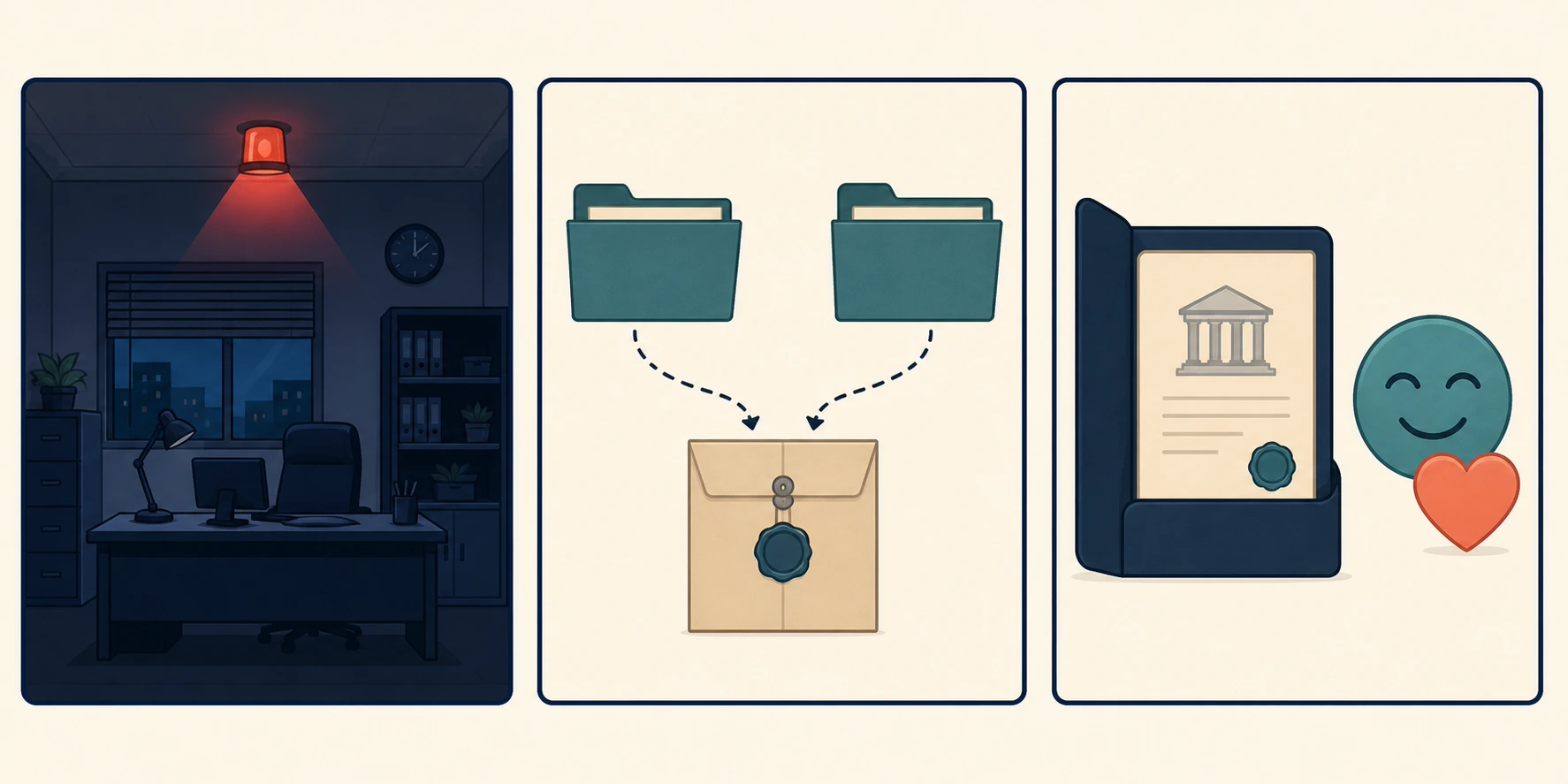
- El mensajero habrá entregado el paquete.The observation happens now. The handover is understood as completed before now. The speaker infers rather than directly witnesses the handover. Choose future perfect for completed-event inference.
Check objective 1Another case
Complete the anterior future with the correct form of haber and an invariable participle: Para entonces, ellas ___ el informe. (terminar)
Complete the pluperfect with the correct form of haber and an invariable participle: Nosotros ya ___ las cartas. (escribir)
Answer available without interaction
Answer: habrán terminado — The anterior future uses habrán plus the invariable participle terminado.
The anterior future uses habrán plus the invariable participle terminado.
Answer: habíamos escrito — The pluperfect uses habíamos plus the invariable participle escrito.
The pluperfect uses habíamos plus the invariable participle escrito.
Check objective 2Another case
A proposed answer is “habrá aprobado” for this case: “The decision is complete before a present reaction. Complete the perfect subjunctive: Me sorprende que el comité habrá aprobado la propuesta sin consultar al equipo. (aprobar)”. Choose the only valid form.
A proposed answer is “habría aprobado” for this case: “The decision is complete before a present reaction. Complete the perfect subjunctive: Me sorprende que el comité habría aprobado la propuesta sin consultar al equipo. (aprobar)”. Choose the only valid form.
Answer available without interaction
Answer: haya aprobado — Me sorprende que selects the subjunctive, while the approval is anterior to the present reaction. Third-person singular perfect subjunctive is haya aprobado.
Me sorprende que selects the subjunctive, while the approval is anterior to the present reaction. Third-person singular perfect subjunctive is haya aprobado.
Answer: haya aprobado — Me sorprende que selects the subjunctive, while the approval is anterior to the present reaction. Third-person singular perfect subjunctive is haya aprobado.
Me sorprende que selects the subjunctive, while the approval is anterior to the present reaction. Third-person singular perfect subjunctive is haya aprobado.
Check objective 3Another case
A proposed answer is “habría salido” for this case: “It is 21:00 now. The office is dark, every desk is empty and the alarm is set. Express a reasoned inference about an earlier departure: El equipo habría salido antes de tiempo. (salir)”. Choose the only valid form.
A proposed answer is “haya salido” for this case: “It is 21:00 now. The office is dark, every desk is empty and the alarm is set. Express a reasoned inference about an earlier departure: El equipo haya salido antes de tiempo. (salir)”. Choose the only valid form.
Answer available without interaction
Answer: habrá salido — The observation is present and the departure is inferred as already complete. Third-person singular future perfect is habrá plus the invariable participle salido.
The observation is present and the departure is inferred as already complete. Third-person singular future perfect is habrá plus the invariable participle salido.
Answer: habrá salido — The observation is present and the departure is inferred as already complete. Third-person singular future perfect is habrá plus the invariable participle salido.
The observation is present and the departure is inferred as already complete. Third-person singular future perfect is habrá plus the invariable participle salido.
What your own language pushes you to say
Wrong Las investigadoras habían entregadas las muestras.
Right Las investigadoras habían entregado las muestras.
In a compound tense the lexical participle remains invariable. Agreement belongs to adjectival or passive-result structures, not to haber + participle.
Challenge: apply every rule
Solve every case and justify each choice: 1) Complete the anterior future with the correct form of haber and an invariable participle: Para entonces, ellas ___ el informe. (terminar) 2) A proposed answer is “habrá salido” for this case: “The decision is complete before a present reaction. Complete the perfect subjunctive: Me sorprende que el comité habrá salido la propuesta sin consultar al equipo. (aprobar)”. Choose the only valid form. 3) A proposed answer is “habría firmado” for this case: “It is 21:00 now. The office is dark, every desk is empty and the alarm is set. Express a reasoned inference about an earlier departure: El equipo habría firmado antes de tiempo. (salir)”. Choose the only valid form.
Answer available without interaction
- Build the complete compound-tense system with the correct form of haber and an invariable participle.
- Locate one completed event before a present, past, future or hypothetical reference point.
- Interpret future, conditional and subjunctive compounds as signals of inference, reported uncertainty or speaker commitment when context licenses those readings.
Answer: habrán terminado · haya aprobado · habrá salido
The anterior future uses habrán plus the invariable participle terminado. Me sorprende que selects the subjunctive, while the approval is anterior to the present reaction. Third-person singular perfect subjunctive is haya aprobado. The observation is present and the departure is inferred as already complete. Third-person singular future perfect is habrá plus the invariable participle salido.
Curriculum alignment and sources
- C1 flexibility includes modifying expression to show degrees of commitment, hesitation, confidence and uncertainty; compound-tense choices are one editorial route to that capacity. · Common European Framework of Reference for Languages: Companion Volume
- The C1 column includes advanced values of future and conditional forms, future perfect and conditional perfect stance, compound-subjunctive correlations, participial restrictions and marked compound forms. · ic-pcic-grammar-c1-c2
Continue along this corridor
Practise this: “Serán las tres”: a future that is not about the futureThe present perfect: a past event connected to nowThe imperfect and pluperfect subjunctive: distance, sequence and unreal framesFuture choices and conditional wishesRegister and politeness: calibrating distance, burden and voice