

CEFR B2
What you will learn
- Match depuis, pendant and il y a to continuity, bounded duration and distance into the past.
- Distinguish dans as a delay before a future event from en as the time needed to complete an action.
Before you start
- Recognise the vocabulary and forms shown in this lesson’s key idea and paradigm.
The idea
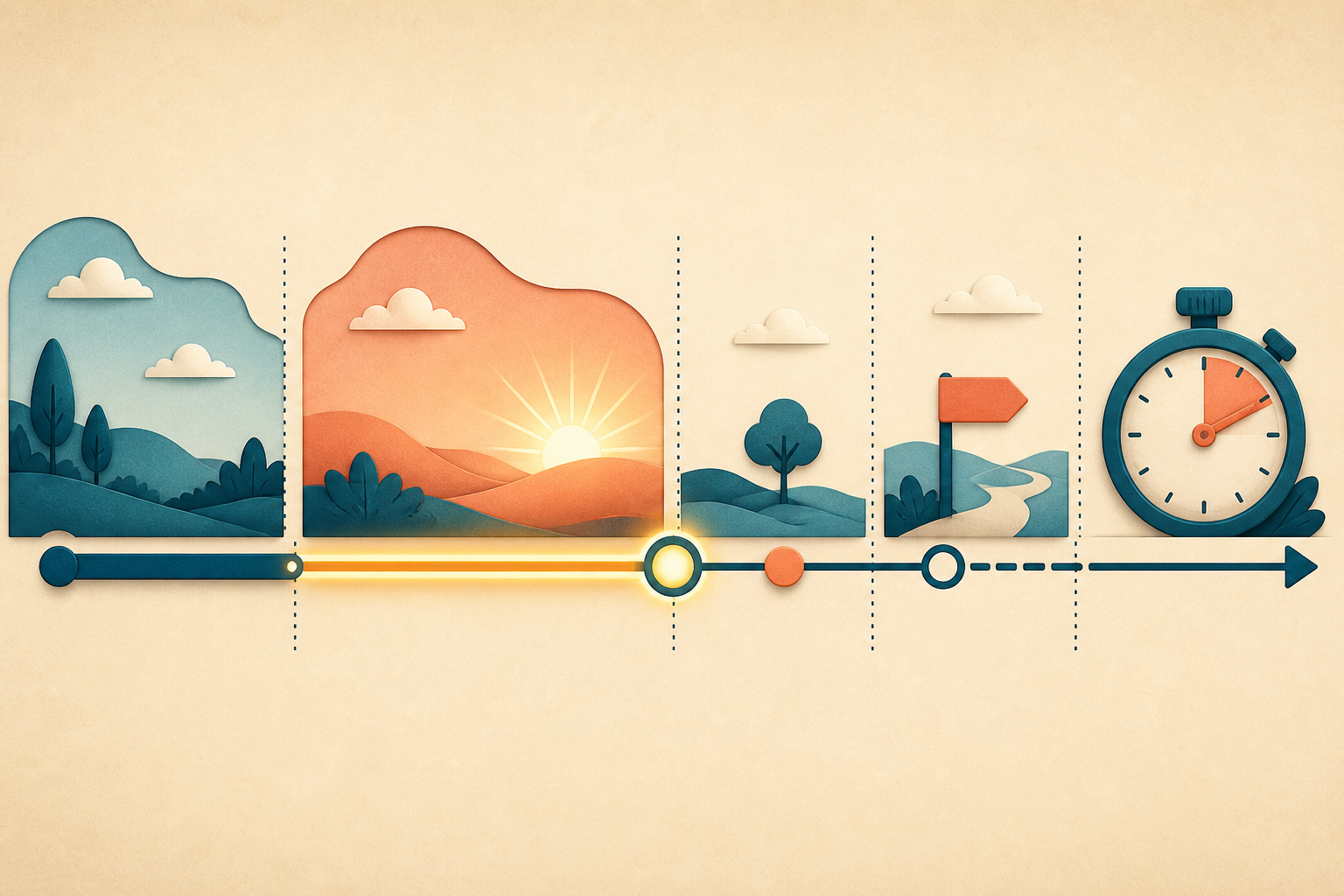
The choice does not depend on the number alone: distinguish continuity from an origin, bounded duration, distance into the past, future delay and completion time.
“Depuis” says since when, and it goes with the present if the thing is still going on: “j'habite ici depuis trois ans” — and I still live here. That present tense is the surprise, because English uses a perfect there.
“Pendant” presents a total duration as a bounded interval: “j’ai vécu à Lyon pendant deux ans”. The interval may be over, but it can also be current or future: “je travaillerai pendant deux heures”. In many contexts the preposition can be omitted: “j’ai vécu deux ans à Lyon”.
“Il y a” says how long ago something happened, and always looks back: “je suis arrivé il y a deux ans”. Do not confuse it with the existence phrase, which is spelt identically.
“Dans” says how soon something will happen, and always looks forward: “le film commence dans dix minutes”. And “en” says how long it takes to complete: “il a fait le trajet en une heure” — it took him an hour, he did not leave in an hour's time.
That last pair is the one English blurs, because your “in” does both jobs: “in an hour” can mean either. French splits them: “dans” marks a future point, “en” measures the effort.
Working paradigm
| Time relation | Expression | Typical tense |
|---|---|---|
| continue depuis | depuis | présent |
| durée délimitée | pendant | présent / passé / futur |
| événement passé | il y a | passé |
| début futur | dans | futur |
| temps de réalisation | en | passé / futur |
The numerical duration alone does not decide: the event’s relation to speaking time matters.
How it sounds
- Le technicien terminera la réparation en quarante minutes.The action is not yet complete. The sentence measures the time needed to finish it. Completion time selects en, not dans.
Check objective 1Another case
We started in January 2024 and continue today: Nous collaborons avec ce laboratoire ___ janvier 2024.
We started in January 2024 and continue today: Nous collaborons avec ce laboratoire ___ janvier 2024.
Answer available without interaction
Answer: depuis — The collaboration continues: depuis links present-tense collaborons to its starting date, January 2024.
The present shows an ongoing collaboration that began in January 2024.
Answer: depuis — The collaboration continues: depuis links present-tense collaborons to its starting date, January 2024.
The present shows an ongoing collaboration that began in January 2024.
Check objective 2Another case
The meeting lasted twenty minutes. Express the time needed to complete it: elle s’est terminée ___ vingt minutes.
The meeting lasted twenty minutes. Express the time needed to complete it: elle s’est terminée ___ vingt minutes.
Answer available without interaction
Answer: en — The sentence measures the twenty minutes needed to complete the meeting.
The sentence measures the twenty minutes needed to complete the meeting.
Answer: en — The sentence measures the twenty minutes needed to complete the meeting.
The sentence measures the twenty minutes needed to complete the meeting.
When it doesn't hold
What breaks the rule, said out loud. Hiding it is what makes you feel cheated in the exam.
- Still continuingElle travaille ici depuis 2022.
- Finished periodElle y a travaillé pendant quatre ans.
- Starts laterElle commencera dans une heure.
What your own language pushes you to say
Wrong Je vis ici il y a cinq ans.
Right Je vis ici depuis cinq ans.
The present shows that the situation continues; il y a would date a past event.
Challenge: apply both rules
Solve both cases and justify each choice: 1) Una propuesta responde «pendant» a este caso: «Nous collaborons avec ce laboratoire pendant janvier 2024.». Elige la única forma válida. 2) Una propuesta responde «dans» a este caso: «La réunion s’est terminée dans vingt minutes.». Elige la única forma válida.
Answer available without interaction
- Match depuis, pendant and il y a to continuity, bounded duration and distance into the past.
- Distinguish dans as a delay before a future event from en as the time needed to complete an action.
Answer: depuis · en
The present shows an ongoing collaboration that began in January 2024. The sentence measures the twenty minutes needed to complete the meeting.
Curriculum alignment and sources
- CEFR B2 · understand complex texts, interact fluently and produce clear, detailed texts; B2.1 is an internal editorial sequence. · Common European Framework of Reference for Languages: Companion Volume
- French-specific reference descriptions used to cross-check B2 forms; they are not a universal school curriculum. · Reference Level Descriptions · French
- La norma estatal usa el MCER como referencia, pero no asigna B2.1/B2.2 a un curso. Este catálogo no crea esa equivalencia. · Real Decreto 243/2022, currículo básico de Bachillerato
- Las fuentes oficiales distinguen recorridos. Este paquete no publica una equivalencia universal B2→ano. · Organização curricular · Francês · iniciação e continuação
- La fuente reutilizada fija A1 al final del primer ciclo y no acredita B2 de Francés en una clase italiana concreta. · Decreto 9 dicembre 2025, n. 221 · nuove Indicazioni nazionali
Continue along this corridor
Practise this: Depuis, pendant, il y a, dans, enAdvanced French negation: restriction, combinations and expletive neGérondif, participe présent and adjectif verbal: three -ant formsPronominal verbs: classes, auxiliary and participle agreementConditional for unconfirmed information: present, past and sourceNominalisation in written French: formation, complements and style