

CEFR A2
What you will learn
- Recall frequent verb patterns with à, with de, and with no preposition before an infinitive.
- Distinguish changes in pattern and meaning such as jouer à/de or penser à/de without word-for-word translation.
Before you start
- Recognise the vocabulary and forms shown in this lesson’s key idea and paradigm.
The idea
The preposition following a verb belongs to its pattern: learn it with the verb and check it in context, because translation cannot choose it reliably.
There is no single reliable semantic rule that separates these three groups. Some verbs take “à”: “commencer à”, “apprendre à”, “réussir à”, “arriver à”, “continuer à”, “hésiter à”. Others take “de”: “essayer de”, “décider de”, “oublier de”, “refuser de”, “finir de”, “arrêter de”. And others take nothing: “vouloir”, “pouvoir”, “devoir”, “aimer”, “préférer”, “espérer”, “aller”, “savoir”.
That third group is the one that trips people up, because it is invisible. “Je veux partir”, “je vais chercher le pain”, “j'espère venir”: there is nothing between the two verbs, and putting something in is as wrong as leaving it out where it belongs.
Learning the preposition separately from the verb does not work, because there is no rule to look up. What works is learning the pair whole: not “decide” and then “de”, but “décider de”, the two words together, as if they were one.
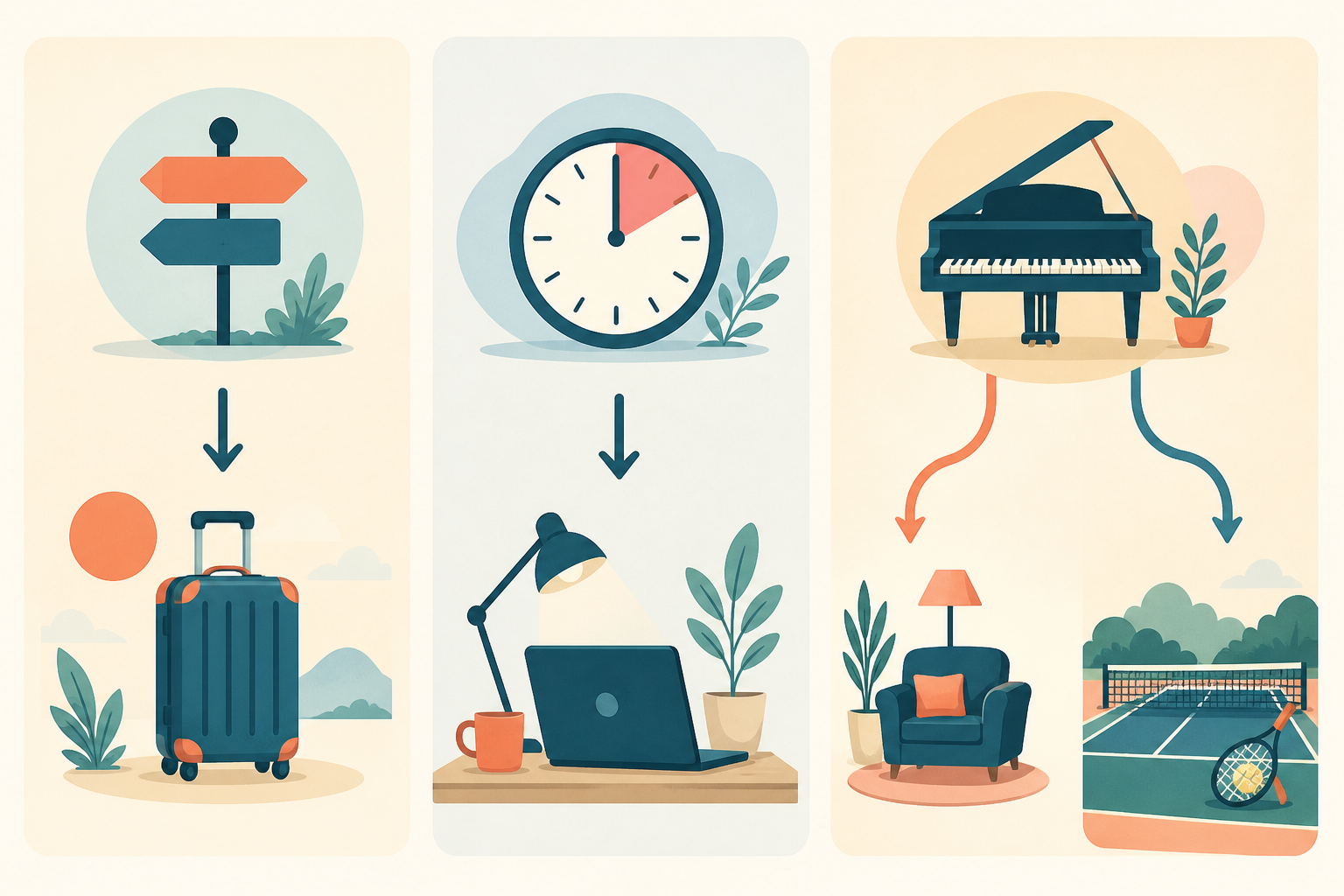
And some verbs change meaning with the preposition rather than changing construction. “Jouer à” is to play a game — “jouer au tennis” — and “jouer de” is to play an instrument — “jouer du piano”. “Penser à” is to have something on your mind; “penser de” is to have an opinion about it.
Verb and preposition
| construction | modèle | complément |
|---|---|---|
| verbe + à | commencer à | commencer à travailler |
| verbe + de | décider de | décider de partir |
| verbe + Ø | vouloir | vouloir venir |
| sens avec à | jouer à | jouer au tennis |
| sens avec de | jouer de | jouer du piano |
How it sounds
- J'ai commencé à travailler à huit heures.In the pattern practised here, commencer takes à before an infinitive.
- Il a décidé de partir tout de suite.“Décider” takes “de”. Learn the pair as one unit.
- Je vais chercher le pain.Nothing goes between “aller” and the infinitive, and that is where an extra preposition sneaks in.
- Elle joue du piano et elle joue au tennis.One verb, two prepositions, two meanings.
Check objective 1Another case
A proposed answer is “à” for this case: “Il a décidé à partir tout de suite.”. Choose the only valid form.
A proposed answer is “pour” for this case: “Il a décidé pour partir tout de suite.”. Choose the only valid form.
Answer available without interaction
Answer: de — Before an infinitive, the pattern practised here is “décider de”.
Before an infinitive, the pattern practised here is “décider de”.
Answer: de — Before an infinitive, the pattern practised here is “décider de”.
Before an infinitive, the pattern practised here is “décider de”.
Check objective 2Another case
Complete the jouer de construction with the instrument’s name: Elle joue ___ piano depuis dix ans.
Complete the jouer de construction with the instrument’s name: Elle joue ___ piano depuis dix ans.
Answer available without interaction
Answer: du — An instrument: “jouer de”, and “de + le” merge into “du”.
An instrument: “jouer de”, and “de + le” merge into “du”.
Answer: du — An instrument: “jouer de”, and “de + le” merge into “du”.
An instrument: “jouer de”, and “de + le” merge into “du”.
When it doesn't hold
What breaks the rule, said out loud. Hiding it is what makes you feel cheated in the exam.
- “Commencer par” and “finir par” are not variants of “à” and “de”: they say where you start or end, not what you do.Il a commencé par nous remercier.
- “Penser à” and “penser de” coexist and do not mean the same thing: one is to have in mind, the other is to have an opinion.Qu'est-ce que tu penses de ce film ? — J'y pense souvent.
What your own language pushes you to say
Wrong Je cherche pour mes clés.
Right Je cherche mes clés.
English verbs carry particles that are part of the meaning — look for, wait for, listen to — and French puts the preposition inside the verb instead: “chercher”, “attendre”, “écouter” take a direct object and nothing else. So your error is an extra word, and it is the same three or four verbs every time.
Challenge: apply both rules
Solve both cases and justify each choice: 1) Una propuesta responde «à» a este caso: «Il a décidé à partir tout de suite.». Elige la única forma válida. 2) Una propuesta responde «au» a este caso: «Elle joue au piano depuis dix ans.». Elige la única forma válida.
Answer available without interaction
- Recall frequent verb patterns with à, with de, and with no preposition before an infinitive.
- Distinguish changes in pattern and meaning such as jouer à/de or penser à/de without word-for-word translation.
Answer: de · du
Before an infinitive, the pattern practised here is “décider de”. An instrument: “jouer de”, and “de + le” merge into “du”.
Curriculum alignment and sources
- CEFR A2 · routine tasks and simple exchanges of direct information. · Common European Framework of Reference for Languages: Companion Volume
- French-specific reference descriptions used to cross-check A2 forms; they are not a universal school curriculum. · Reference Level Descriptions · French
- MCER como referencia; sin asignación estatal A2.1/A2.2 por curso. La máscara 3.º/4.º ESO del catálogo es editorial. · Real Decreto 217/2022, currículo básico de ESO
- El dossier validado acredita itinerarios distintos. Este paquete no publica una equivalencia universal A2→ano. · Organização curricular · Francês · iniciação e continuação
- La fuente reutilizada fija A1 al final de la secundaria de primer grado para esta materia. No se atribuye A2 a un curso italiano. · Decreto 9 dicembre 2025, n. 221 · nuove Indicazioni nazionali
Continue along this corridor
Practise this: Verbs with à, with de and with nothingLe, la, les, lui or leur: object and positionEn and y: replacing quantities, de, à and placesImparfait or passé composé: setting, habit and eventFuture and conditional: stems, endings and usesQui, que, où or dont: find the gap