

Il present continuous: quello che sta succedendo adesso
QCER A2
Che cosa imparerai
- Riconoscere present continuous e azioni in corso in brevi esempi di livello A2.
- Applicare present continuous e azioni in corso a prove visive esplicite senza copiare un modello svolto.
- Giustificare le tre risposte con la regola e la prova visibile.
L'idea
Il present continuous si fa con to be più il verbo in -ing, e serve per ciò che accade mentre parli o per ciò che dura solo un periodo.
La forma è to be più -ing, e il to be è quello che già conosci: I am working, she is working, they are working. Per negare, not va dopo il to be: I'm not working. Per domandare, il to be va davanti: Are you working?
La differenza con il present simple non è di tempo, è di sguardo. I work in a bank dice di cosa ti occupi; I'm working today dice cosa stai facendo oggi, magari perché di solito sei libero. Sono due presenti, ma uno descrive la tua vita e l'altro questo momento.
C'è un secondo sguardo, quello del temporaneo: qualcosa che dura un periodo e finirà. She's living with her parents this month. Non sta succedendo proprio adesso —forse adesso è al lavoro—, ma è un periodo con un inizio e una fine.
E c'è un terzo uso che sorprende: il present continuous vale anche per il futuro, quando l'hai già deciso e organizzato. I'm meeting Sara tomorrow. Non è che ti stia accordando adesso; è che l'accordo c'è già.
L'-ing ha tre aggiustamenti di scrittura. Se il verbo finisce in -e muta, la -e cade: write dà writing, make dà making. Se finisce con vocale breve più consonante, quella consonante raddoppia: run dà running, sit dà sitting. E se finisce in -ie, diventa -y: lie dà lying.
Resta il punto in cui si sbaglia di più, ed è di significato, non di forma. C'è un gruppo di verbi che parlano di stati e non di azioni —know, want, need, like, hate, believe, belong, seem, understand— e nell'uso normale non si mettono al continuo: si dice I know the answer, non «I am knowing». Avviso importante per non sentirti ingannato più avanti: alcuni di questi verbi al continuo ci vanno quando cambiano significato, come I'm thinking about it (ci sto riflettendo) contro I think you're right (la mia opinione), o We're having lunch, dove have non è più avere ma mangiare.
Forme complete
| Soggetto | Affermativa | Negativa | Domanda |
|---|---|---|---|
| I | I am working | I am not working | Am I working? |
| you | you are working | you are not working | Are you working? |
| he | he is working | he is not working | Is he working? |
| she | she is working | she is not working | Is she working? |
| it | it is working | it is not working | Is it working? |
| we | we are working | we are not working | Are we working? |
| they | they are working | they are not working | Are they working? |
Ortografia di -ing
| Base | Cambio | Forma |
|---|---|---|
| work | + ing | working |
| make | drop final e | making |
| run | double final consonant | running |
| lie | ie → y | lying |
Come suona
- Look! It's raining again.Sta succedendo in questo secondo, davanti a tutti e due. È l'uso centrale.
- I work in a bank, but this week I'm working from home.I due tempi nella stessa frase: la vita e questa settimana.
- We're having dinner at eight tonight.Futuro già organizzato. E qui have significa cenare, non avere.
- She isn't studying at the moment. She's watching a film.Negativa: not sta attaccato al to be, mai all'-ing.
- I don't understand this exercise.Understand è uno stato: anche se è proprio adesso, va al present simple.
Ora tocca a te
Due o tre, per verificare che quanto sopra si sia capito.
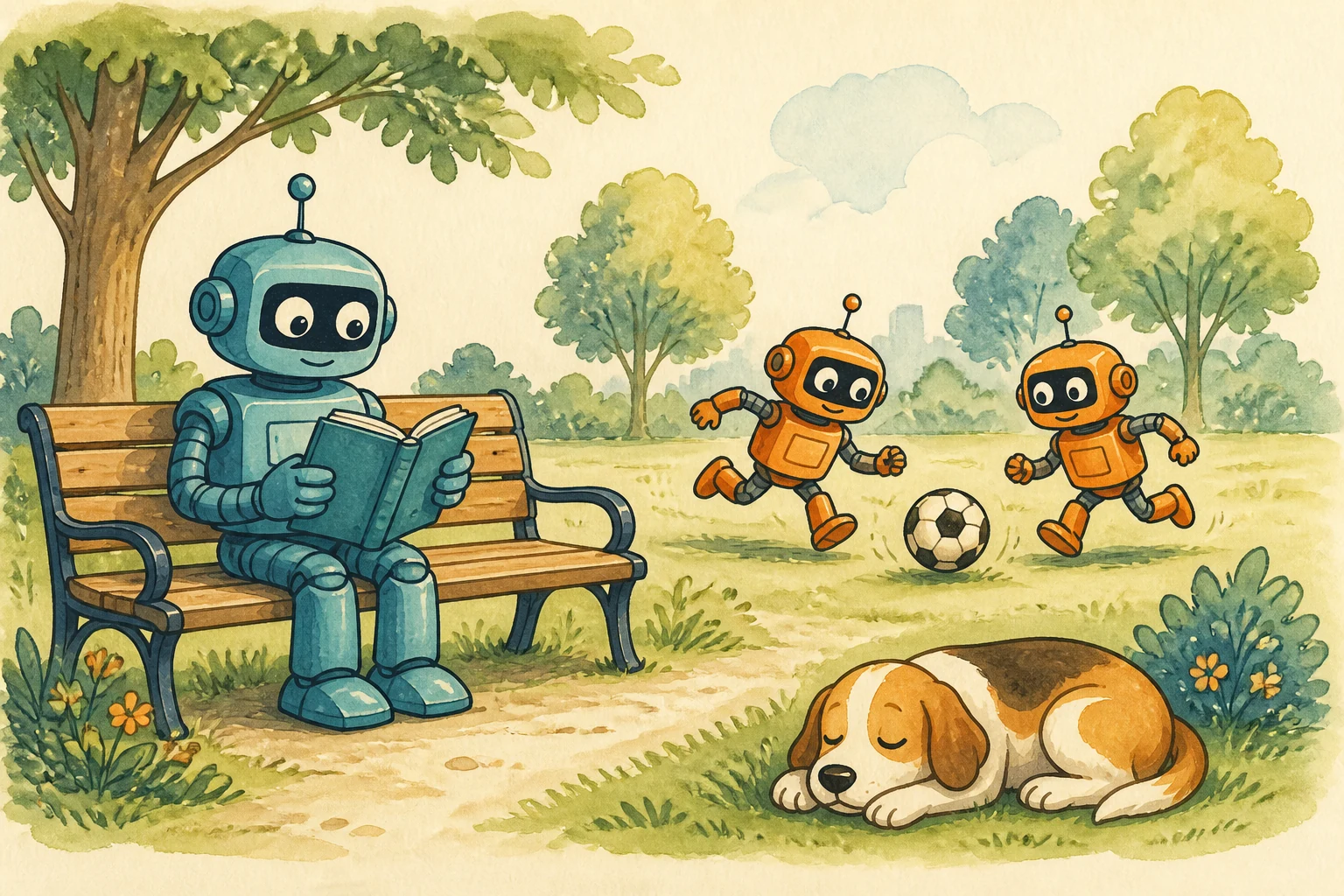
Focus on the teal robot. Choose the sentence that matches the scene.
The teal robot is reading on the bench. — L'azione è in corso e robot richiede is + reading.
Focus on the two orange robots. Choose the complete present continuous form.
The orange robots are playing football. — Il soggetto plurale robots seleziona are e play prende la forma playing.
Use both facts visible in the foreground. Which sentence is correct?
The dog isn't running; it is sleeping. — La negativa usa is not e l'azione visibile usa is + sleeping.
Quando non vale
Ciò che rompe la regola, detto. Nasconderlo è ciò che ti fa sentire ingannato all'esame.
- Alcuni verbi di stato al continuo ci vanno, ma allora cambiano significato.I think you're right. / I'm thinking about your idea.
- Con always, il continuo non parla di adesso: esprime fastidio per qualcosa che si ripete troppo.He's always losing his keys!
- I verbi che parlano dei sensi di solito vanno con can invece che al continuo.I can hear something. I can smell coffee.
- E anche se have di solito è uno stato, quando significa mangiare, passare del tempo o farsi una doccia il continuo lo accetta.They're having a great time. I'm having a shower.
Quello che la tua lingua ti spinge a dire
Si dice male Look! It rains.
Si dice bene Look! It's raining.
L'italiano usa il presente semplice per quasi tutto e tiene «sto facendo» per insistere: «piove» basta e avanza. In inglese quel present simple significa che piove di solito, non che sta piovendo adesso. Quando c'è un Look! o un at the moment, la forma è to be più -ing, e il to be non si può saltare.
Allineamento curricolare e fonti
- QCER A2 · repertorio per scambi semplici e compiti abituali; collocare present continuous e azioni in corso e dividere A2.1/A2.2 è una progressione editoriale, non un inventario grammaticale prescritto dal QCER. · Common European Framework of Reference for Languages: Companion Volume
- Descrizioni specifiche dell'inglese usate per verificare present continuous e azioni in corso; non costituiscono un curricolo scolastico. · Reference Level Descriptions developed so far