

Il present simple: quello che fai sempre
QCER A1
Che cosa imparerai
- Riconoscere present simple per abitudini e fatti in esempi brevi.
- Scegliere una forma di present simple per abitudini e fatti da un'evidenza visiva esplicita.
- Giustificare le tre risposte con la regola insegnata.
L'idea
Il present simple è il tempo di ciò che si ripete e di ciò che è vero sempre, e la sua unica complicazione è una -s che compare solo con he, she e it.
Si usa per tre cose: quello che fai di abitudine (I get up at seven), quello che è vero sempre (Water boils at 100 degrees) e quello che senti o pensi (I like coffee, I don't understand). Nota che nessuna delle tre è «proprio adesso»: per quello c'è un altro tempo, che vedrai nel present continuous.
La forma è la più semplice della lingua: il verbo così com'è. I work. You work. We work. They work. E poi arriva l'unica seccatura: con he, she e it si aggiunge -s. He works. She lives. It rains. Nient'altro, ma è proprio quello che si dimentica di più, perché l'italiano cambia la desinenza in tutte le persone e un solo segno sembra un dettaglio.
La -s ha gli stessi aggiustamenti del plurale. Se il verbo finisce in -s, -sh, -ch, -x o -o, si aggiunge -es: he watches, she goes, he does. Se finisce in consonante più -y, la -y diventa -ies: study dà studies, fly dà flies. E have è speciale: he has.
Per negare e per domandare compare un aiutante che in italiano non esiste: do. Con he, she e it diventa does. I don't like fish. She doesn't live here. Do you speak English? Does he work on Saturdays?
Ed ecco la regola d'oro di questa unità: quando compare do o does, la -s è già stata usata, quindi il verbo torna nudo. Si dice Does she work? e She doesn't work, mai «Does she works?». Il segno della terza persona c'è una volta sola, ed è già dentro does.
Un'ultima nota che risparmia guai: con il verbo to be non si usa do per niente. Are you tired?, non «Do you be tired?».
Paradigma completo del present simple
| Persona | Affermativa | Negativa | Domanda |
|---|---|---|---|
| I | I work | I don't work | Do I work? |
| you | you work | you don't work | Do you work? |
| he | he works | he doesn't work | Does he work? |
| she | she works | she doesn't work | Does she work? |
| it | it works | it doesn't work | Does it work? |
| we | we work | we don't work | Do we work? |
| they | they work | they don't work | Do they work? |
Come suona
- I get up at seven and I have breakfast at half past seven.Pura routine: per questo va al present simple anche se oggi non l'hai fatto.
- My sister works in a hospital.My sister è come she: work diventa works.
- Does your father speak French?La -s è finita in does, quindi speak resta nudo.
- We don't watch television in the morning.Con we l'ausiliare è do, e don't è la contrazione normale parlando.
- She always goes to bed early.Always va tra il soggetto e il verbo, non alla fine come in italiano.
Ora tocca a te
Due o tre, per verificare che quanto sopra si sia capito.
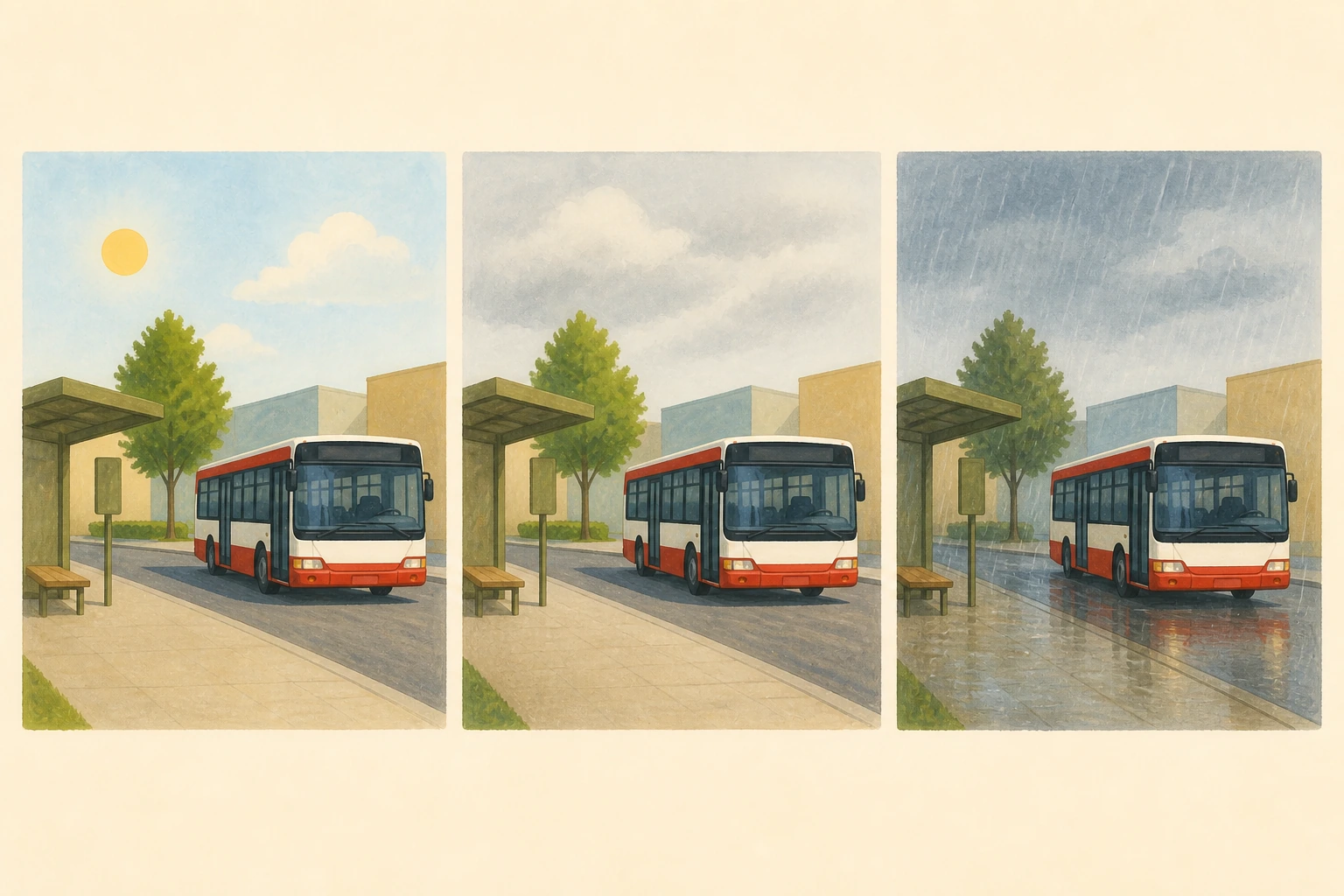
The three panels show the same routine. Choose the correct sentence.
The bus stops here every day. — Bus equivale a it ed every day indica un'abitudine: stops prende -s.
Which question asks whether the bus arrives in all three panels?
Does the bus arrive in all three panels? — Con it si usa does e il verbo principale torna alla base: arrive.
The bus does not miss the stop in any panel. Choose the correct negative.
It doesn't miss the stop. — Doesn't porta già la marca della terza persona; miss resta alla forma base.
Quando non vale
Ciò che rompe la regola, detto. Nasconderlo è ciò che ti fa sentire ingannato all'esame.
- Il present simple vale anche per il futuro quando si tratta di un orario fisso: treni, aerei, lezioni, cinema.The train leaves at 6:15 tomorrow.
- Con I e you, do si usa anche per insistere nell'affermativa. Lì non è una domanda: è enfasi.I do like it! (de verdad que me gusta)
- Have è l'unico verbo con una terza persona tutta sua: has, non «haves».She has two brothers.
- Gli avverbi di frequenza vanno prima del verbo, ma dopo to be.He never eats meat. / He is never late.
Quello che la tua lingua ti spinge a dire
Si dice male She go to school by bus and she not study on Sundays.
Si dice bene She goes to school by bus and she doesn't study on Sundays.
L'italiano cambia la desinenza in ogni persona (vado, vai, va), quindi una -s isolata sembra trascurabile e sparisce. E per negare l'italiano mette «non» davanti al verbo: «non studia». In inglese non basta not: serve doesn't, e dopo il verbo torna alla forma base.
Allineamento curricolare e fonti
- QCER A1 · repertorio linguistico elementare per bisogni concreti; collocare present simple per abitudini e fatti e dividere A1.1/A1.2 è una progressione editoriale, non un inventario grammaticale prescritto dal QCER. · Common European Framework of Reference for Languages: Companion Volume
- Descrizioni di livello specifiche per l'inglese usate come confronto linguistico per present simple per abitudini e fatti; non costituiscono un curricolo scolastico. · Reference Level Descriptions developed so far
Continua lungo questo corridoio
Esercitarsi su questo: La -s di he, she e itGli articoli: a, an, the e quando non se ne mette nessunoHave e have got: dire quello che hai